| 日期 16 January 2026
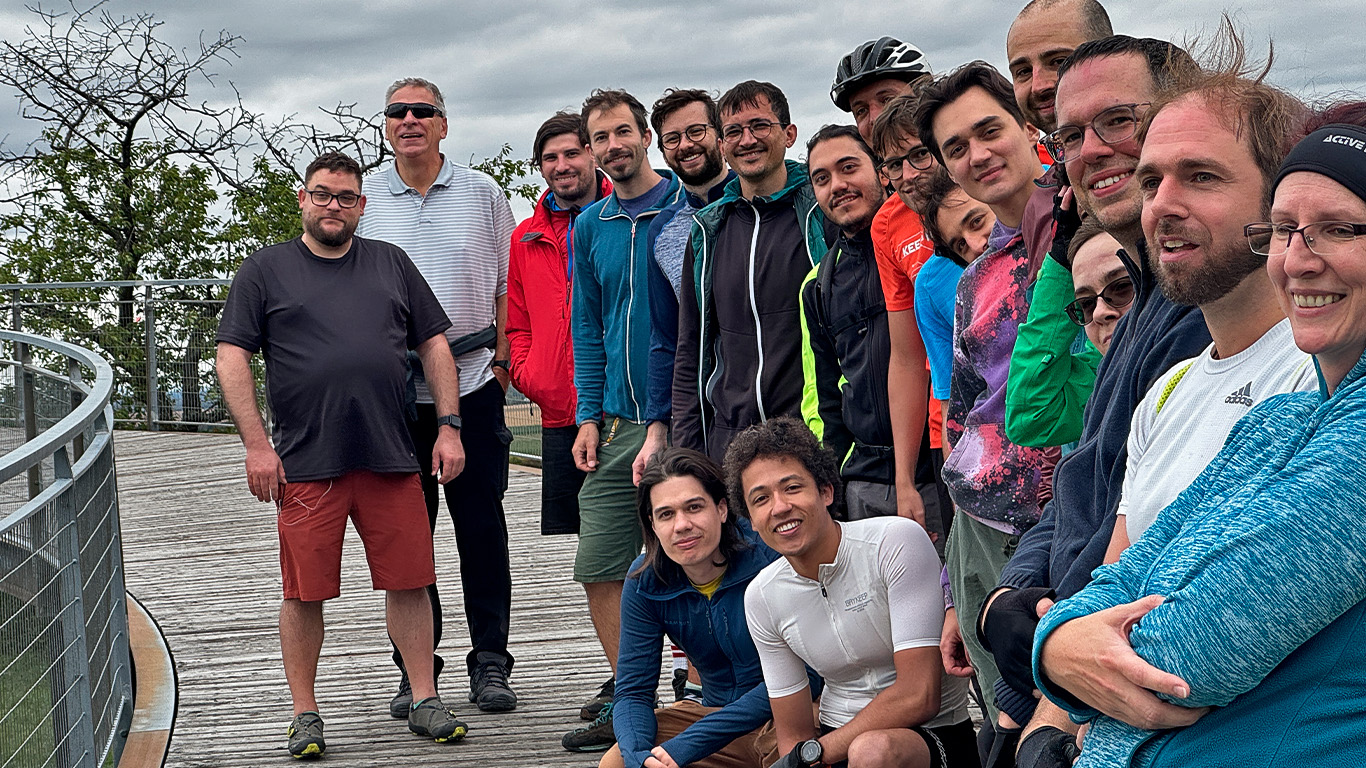
The research group at TU Wien began exploring electron–photon correlations in electron microscopy with the goal of confirming an effect that had previously been predicted only in theory. Alexander Preimesberger joined the group in late 2021 as a master’s student, while the project was still in its early stages. Sergei Bogdanov later contributed further experimental work during his PhD. The group aimed to demonstrate the quantum correlations between electrons and photons in a transmission electron microscope.1
Initially, they conducted simple photon–photon experiments; for this, they unpacked their Swabian Instruments Time Tagger Ultra (TTU) and used it directly with the GUI. Alexander said, “It was super simple,” and remembers that the first publication coming from the lab at that time used data taken entirely from the GUI without needing any code. The Time Tagger quickly became a stable part of their setup as they explored more ideas.
In the early stages, the team was unsure of how to design an experiment that could reveal electron–photon correlations. Alexander described the first year as a time of uncertainty in which they tried many experimental approaches: “We didn’t know much of anything.”
Working with tiny mirrors, custom-made for the confined space inside the electron microscope, achieving the required spatial resolution was a significant challenge. Initially, the photon images displayed large, blurry shapes. Alexander recalled that the photon beams appeared as “blobs of 50 or 100 micrometers,” although they knew they needed much better spatial resolution of about 5 micrometers. It was unclear whether they could ever reach that level of precision.
Additionally, the setup itself was quite complex. They had to bring together a single-photon detector and a single-electron camera, and then correlate all events with high timing accuracy. The count rate was also low, which made the experiments slow.
As the experiment progressed, the team realized the importance of the Time Tagger’s flexibility. They had originally purchased it for standard photon experiments, but over time, they changed their setup several times.
The transition from GUI-based measurements to full control via the Python API happened naturally as the project grew. The Time Tagger enabled them to transition from a simple starting point to a complex hybrid experiment without requiring hardware replacement or redesigning their timing system.
In the final version of the experiment, the Time Tagger Ultra became the timing center of the system. The single-photon detector sent all detection events to the Time Tagger.2 The electron detector, a Timepix camera, provided its clock-out and trigger-out signals, which were also connected to the Time Tagger. The team used the software clock feature of the Time Tagger to synchronize the camera’s clock with the Time Tagger’s internal clock.
The Time Tagger Ultra ran continuously and collected all photon events. When a trigger arrived from the electron camera, the system marked the relevant time window and stored those photon events. Meanwhile, the electron events were stored separately. Because both the Timepix system and the Time Tagger had Python APIs, the team merged these data streams early in their analysis, allowing them to check correlations in real-time. Sergei mentioned, “Programming with the TimeTagger API has never been a problem.”
He also emphasized that the Time Tagger was not the limiting part of the experiment. According to him, “The Time Tagger is not the bottleneck at all.” The electron detector had a much larger timing jitter, which was the real limiting factor. The team is currently working on improving the electron timing performance and expects progress soon.
Over the course of four years, the group has produced several key publications that mark its progress. The first was a study of classical momentum correlations, showing how an electron can be kicked by a single photon. Following that was a theory paper on how to construct tests for electron–photon entanglement. Later, they published a paper in which they demonstrated electron–photon entanglement in their setup. Most recently, they demonstrated the first two-dimensional ghost image based on these quantum electron-photon correlations.3
Through all of this, the Time Tagger remained a stable and flexible part of their setup. Sergei explained, “It’s definitely one of those devices where you get what you paid for.” The ability to reuse the same device through all stages saved the team time and helped the experiment develop smoothly.
“We were able to adapt it to all of our needs along the way,” Alexander said, reflecting on how the Time Tagger followed the project from simple beginnings to complex quantum experiments.
Today, Alexander, Sergei, and their team have reached the effect they spent years searching for. They have demonstrated electron–photon correlations, shown entanglement, and even utilized these correlations for the first proof-of-principle imaging method. Their long-term vision is to utilize the quantum advantages of entanglement pairs, so that one day a transmission electron microscope could evolve into a hybrid quantum architecture that merges the advantages of photon and electron technologies.
A. Preimesberger, S. Bogdanov, I. C. Bicket, P. Rembold, and P. Haslinger, “Experimental Verification of Electron-Photon Entanglement,” arXiv, Apr. 2025. Available: https://doi.org/10.48550/arXiv.2504.13163 ↩︎
A. Preimesberger, D. Hornof, T. Dorfner, T. Schachinger, M. Hrťon, A. Konečná, and P. Haslinger, “Exploring Single-Photon Recoil on Free Electrons,” Phys. Rev. Lett., vol. 134, no. 9, p. 096901, 2025. https://doi.org/10.1103/PhysRevLett.134.096901 ↩︎
S. Bogdanov, A. Preimesberger, I. C. Bicket, P. Haslinger, et al. “Ghost imaging with free electron-photon pairs”, arXiv, Sep. 2025. Available: https://doi.org/10.48550/arXiv.2509.14950 ↩︎