How Time-Tagged Data Pipelines Unlock Better Experiments for Sensing and Beyond
作者 Maré Sutphen and Kim Ruvolo | 日期 20 May 2026
Researchers can now build secure, replayable data pipelines for precision timing experiments by combining Swabian Instruments' high-resolution Time Tagger hardware with the Necara Solutions Osteo Data Processing Engine. The integration enables real-time encryption, multi-sensor fusion, and variable-rate data replay, unlocking new capabilities for radar analysis, fiber-optic sensing, and navigation systems. Together, the two platforms offer a scalable foundation for capturing, protecting, and reanalyzing high-rate time-tagged data across complex, long-running experiments.
High-rate, time-tagged data is foundational to precision sensing and timing applications, but managing, securing, and reanalyzing that data can present challenges.
Through a collaboration between Swabian Instruments and Necara Solutions, researchers can now move beyond raw time tags to a secure, flexible, and re-playable data pipeline using the Osteo Data Processing Engine (Osteo DPE™).
By integrating Osteo DPE with Swabian Instruments’ time-tagging hardware, teams gain the ability to encrypt data in real time using classical encryption standards, fuse time-tags with additional sensor data, record and replay experiments, and analyze long-running data sets without disrupting live operations. This unlocks new capabilities for quantum computation, advanced sensing, and multi-sensor fusion applications.
Why Swabian Instruments?
Swabian Instruments’ time-tagging hardware delivers the precision and scalability required for modern high-performance sensing systems, making it a natural fit for Osteo’s data management framework.
Key capabilities include:
- Sub-nanosecond resolution with unit-dependent RMS jitter from 2 ps to 42 ps.
- Scalable channel configurations, from 4 up to 160 channels, supporting complex multi-detector experiments.
- High-throughput data transfer, ranging from 9M tags/s via USB 2.0, 90M tags/s via USB 3.0, to 1.2G tags/s via QSFP+.
Pairing Swabian Instruments with Osteo Data Processing Engine
When paired with Osteo DPE, these capabilities extend beyond capture alone. The system automatically segments and compresses high-rate data streams, making it practical to record extended experiments, flight tests, or operational deployments without overwhelming storage or compute resources.
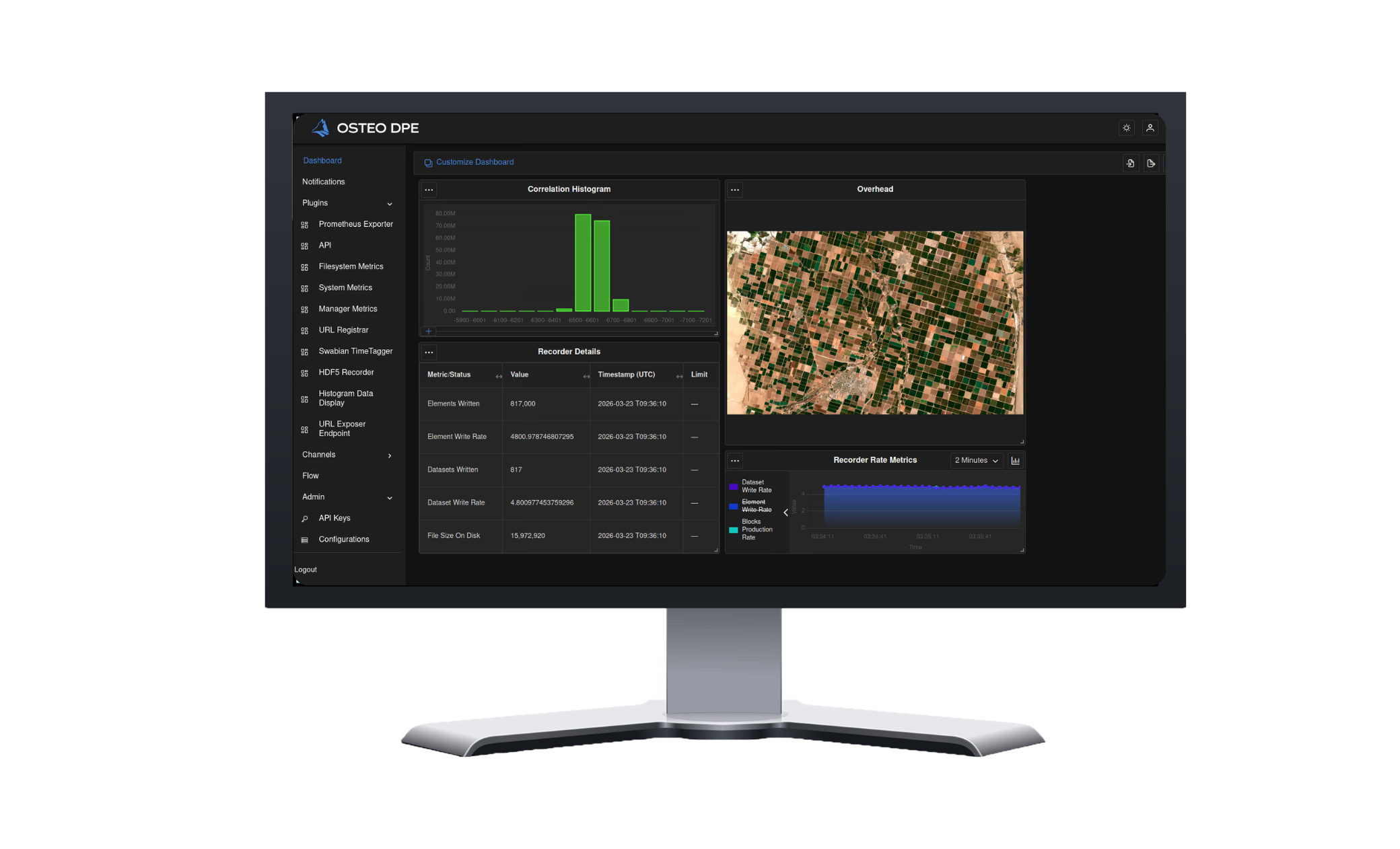
With the Osteo interface, researchers can also monitor correlation histograms and chart count rates in real time, gaining immediate insight while experiments are still running, rather than waiting for post-processing.
The following are the benefits achieved by combining Swabian Instruments with Osteo:
- Secure recording, replay, and post-analysis
- Radar pulse analysis in flight testing
- Fiber delay and propagation analysis
- Multi-sensor fusion for navigation and tracking
Secure Recording, Replay, and Post-Analysis
One of the biggest challenges in precision-timing research is understanding why an experiment behaved the way it did, often long after it finished.
Osteo DPE enables variable-rate playback, allowing teams to replay experimental or operational data at any speed while preserving precise timestamp and time-of-day correlation across multiple systems. This makes it easier to refine algorithms, debug anomalies, and compare outcomes across repeated or long-running experiments.
Built-in AES and RSA encryption, with per-channel key support, ensures sensitive research data remains protected whether it’s transferred across networks or stored in the cloud. This is the same industry-standard encryption used across sectors today, making it well-suited for protecting operational and research data at scale.
Radar Pulse Analysis in Flight Testing
In flight-test environments, Time Taggers can be distributed across airborne platforms to analyze inbound radar pulses even in non-pressurized vessels. Using Osteo’s alignment of the Swabian Time Tagger data, flight test teams can consolidate radar pulse analyses from multiple points on the airframe, assessing cable delays in test, and merge the data to analyze emitter characteristics during operations
Fiber Delay and Propagation Analysis
In fiber-optics environments, teams can capture and analyze fiber delays, evaluating pulse correlations with sub-nanosecond resolution (~100 picoseconds). This level of precision is critical for understanding delay propagation, fiber reflection behavior, and synchronization across complex sensor networks - directly impacting system performance.
Multi-Sensor Fusion for Navigation and Tracking
Modern navigation and tracking systems rely on data from multiple sensor types, each with unique timing characteristics. Swabian Instruments’ time-tagging hardware can be fused within Osteo’s wide range of inputs, which includes:
- GPS/GNSS location data with precise temporal alignment
- RFID scan events for asset tracking and authentication
- Spectral sensors for environmental monitoring
- Geo-annotation tagging that links sensor data to precise locations
- Bluetooth and GNSS proximity detection for context-aware applications
- Cameras(Still/Video) for visual insight and context
Through this partnership, researchers can combine Swabian’s timing precision with Osteo’s advanced data fusion, orchestration, and visualization tools. Osteo’s customizable dashboards make it easy to monitor data flows, view video streams, and track system health, all from a single interface.
Ready to Improve Your Sensing or Precision Timing Workflow?
Whether you’re refining algorithms or managing complex multi-sensor experiments, Swabian Instruments and Osteo DPE provide a scalable, secure foundation for modern research.
Contact solutions@swabianintruments.com or visit Necara Solutions to learn how Osteo DPE and Swabian Instruments’ Time Taggers can transform how you capture, protect, and analyze your data.