作者 | 日期 17 February 2026
The transition from few to many-photon quantum systems results in a fundamental shift in experimental quantum optics. Multi-photon entanglement, high-dimensional quantum states, and spatially resolved quantum imaging all require multi-channel detector systems that preserve single-photon timing resolution across tens of channels simultaneously. However, scaling the detector channel count introduces a critical challenge: maintaining subnanosecond precision while processing photon-detection events at aggregate rates approaching gigacounts per second.
Recent developments in superconducting nanowire single-photon detectors (SNSPDs) have achieved detection efficiencies above 90% with timing jitter below 50 ps across the board in high channel count systems. Yet these advances in detector technology can outpace the capabilities of conventional time-to-digital converters (TDCs), creating a measurement bottleneck on the electronics side. A recent development combining two 32-channel Quantum Opus SNSPD systems with Swabian Instrument Time Tagger X devices demonstrates how this limitation can be addressed through scalable timing architectures designed specifically for high-channel-density quantum measurements.
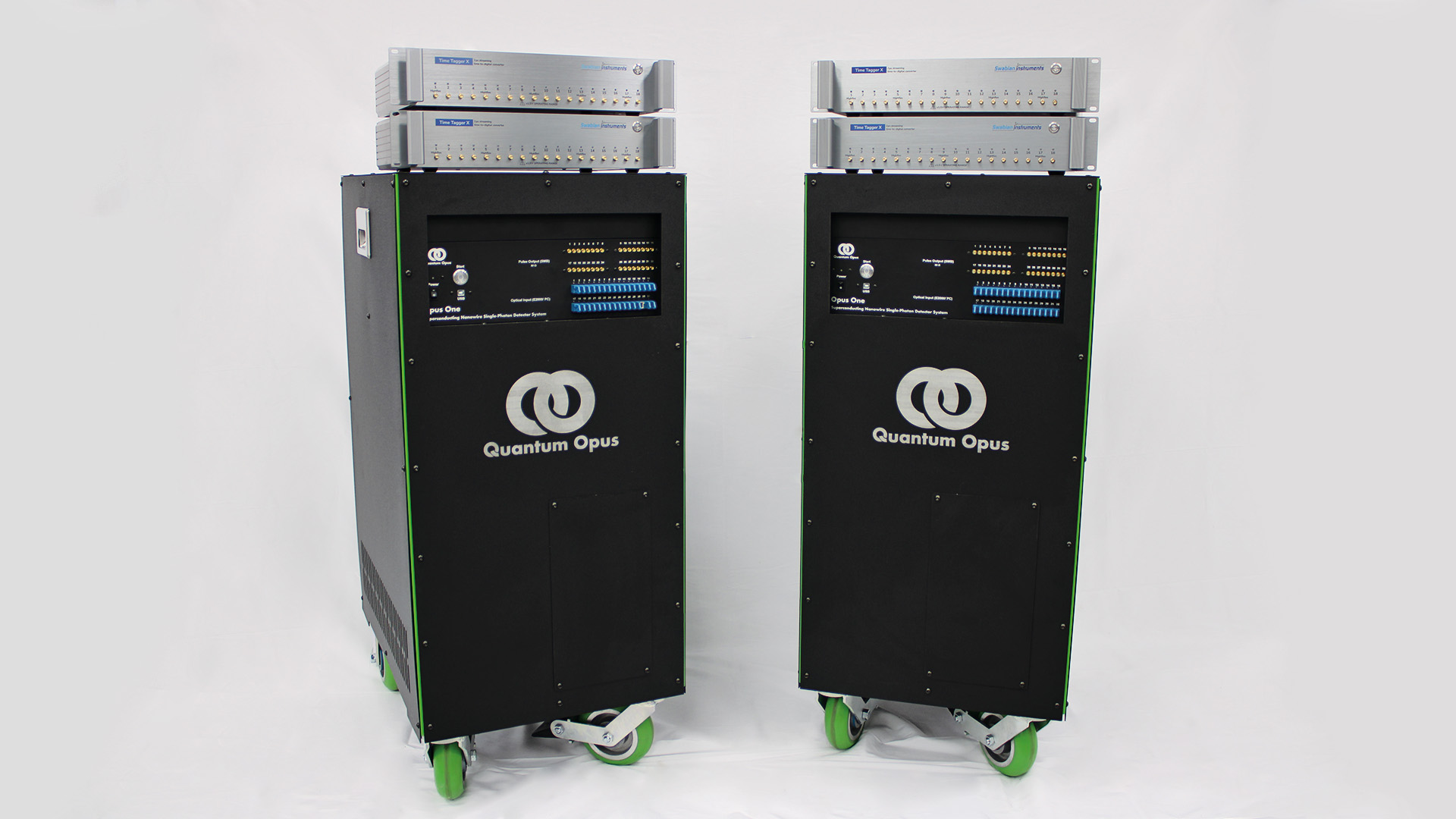
Quantum Opus’s 64 channels of superconducting nanowire single-photon detectors achieve an average per channel performance of 91 % efficiency, 36 ps FWHM timing jitter, and 50 ns recovery time to 98% efficiency. At 50 ns, each channel can theoretically sustain up to 20 million counts per second (Mcts/s) before detector saturation, yielding an aggregate rate of 1.28 gigacounts per second (Gcts/s) across all 64 channels. At these data rates, three technical requirements emerge: time-stamping precision, inter-channel correlation, and sustained high data rates.
Time-stamping precision: each detection must be time-tagged with high resolution to not degrade the overall system performance, ideally with TDC jitter below ~20 ps FHWM.
Inter-channel correlation analysis: many quantum experiments require real-time correlation measurements from the detector, e.g., computing N-fold coincidences across 64 channels at gigacount rates demands special hardware and software architecture.
Sustained throughput without data loss: It is important that the electronic inputs and aggregated acquisition rates streamed to the PC match the detector’s total throughput to avoid data losses.
Multiple Swabian Instruments Time Tagger X modules can be synchronized to operate under a single clock without degrading performance, accommodating up to 160 channels in total (each system has 20 input channels). The jitter of each input channel is <4 ps FHWM, which is well suited to match the precision of the SNSPDs. Field-programmable gate array (FPGA)-based correlation logic enables fast acquisition and transfer of timestamped events to the PC (up to 700 MHz input frequency per channel). This data is streamed in real time, and N-fold coincidence counting across all channels with adjustable coincidence windows can be performed on the fly. While the USB interface bandwidth is limited to 90 MTags/s, the Time Tagger X can also accommodate an FPGA output to a secondary FPGA to achieve up to 1.2 GTags/s in fast-feedback applications.
The combination of high-channel-count, high-efficiency Quantum Opus SNSPD Systems with matched multi-channel Swabian Instruments’ Time Tagger X units removes the experimental constraints associated with the trade-off between the number of inputs and timing performance. Several research directions are opened from this capability:
Quantum Communication experiments using high-throughput or high-dimensional (e.g., leveraging spatial and/or temporal modes) encoding.
Photonic Quantum Computing, involving increasingly complex photonic circuits and boson sampling experiments that scale with detector count, requires matching electronics capable of handling the increased throughput.
Quantum Imaging and Microscopy leveraging time-resolved single-photon counting techniques that require parallelization across spatial pixels and high frame rates, such as those that need reduced phototoxicity in biological samples.
Fundamental Physics is concerned with the characterization of exotic states of light, such as multipartite entanglement studies, Bell tests, and photon number metrology.
As quantum experiments continue to scale in complexity and number of photons, detector arrays and timing electronics must also evolve. The challenge is not solely to increase the channel count, but to do so while preserving the detection efficiency and single-photon timing resolution that enable high-fidelity, scalable quantum measurements. The deployment of Quantum Opus SNSPDs in combination with Swabian Instruments Time Tagger X systems has now enabled 64-channel quantum experiments at performance levels previously accessible only at low channel counts. This removes a critical bottleneck in experimental quantum optics and lays the foundation for next-generation quantum technologies that require increasingly complex parallel single-photon detection schemes.