作者 | 日期 17 February 2026
At the end of January 2026, Swabian Instruments attended the Precise Time and Time Interval (PTTI) Systems and Applications Meeting for the first time, an important step toward a better understanding and support of the timing and frequency metrology community.
Originally, our Time Taggers were primarily intended for photonics, quantum optics, and time-correlated single-photon counting (TCSPC) applications. Over the last few years, Time Taggers have increased their presence in applications that involve time interval analysis, precision time monitoring, and frequency analysis. PTTI is a great opportunity to connect with the experts working on everything from optical atomic clocks and GNSS (Global Navigation Satellite System) applications.
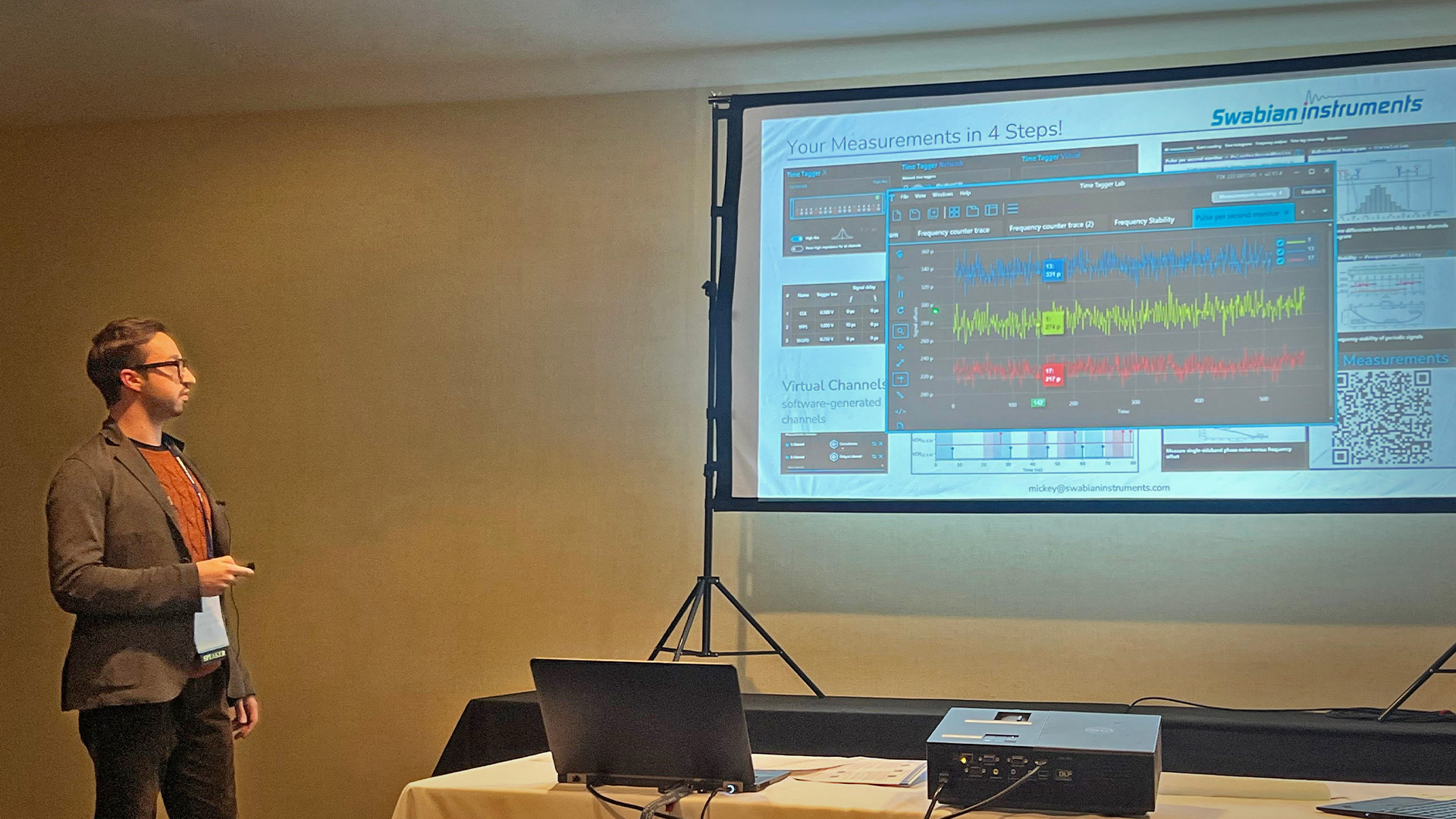
PTTI has been an opportunity to learn how Swabian Instruments’ technology fits into this ecosystem, and to reconnect with some fellow scientists whose interests span precise timing and quantum optics/photonics applications! PTTI’s audience differs markedly from the photonics and quantum events we typically attend, with a focus on operational reliability beyond fundamental research. These include: ensuring ns-level synchronization for GPS (Global Positioning System) satellites, long-term validation of atomic clock performance, and establishing time standards that will govern future lunar infrastructure. Across this variety of applications, one requirement was shared amongst multiple topics: reliable time-interval measurement with minimal dead time and highest timing precision.
The tutorials on the first day emphasized the ability of optical clocks to achieve stabilities orders of magnitude better than those of state-of-the-art cesium fountain clocks. Metrology groups across the globe (INRIM, NICT) have explored both single-transition and ensemble-based definitions, each with distinct implications for frequency standard comparison and validation. As a result of these advancements, a roadmap has been defined to redefine the SI (International System of Units) second based on optical transitions by 2030.
A combination of tutorials and technical sessions highlighted the importance of GNSS time transfer, alternative PNT (Position, Navigation, Timing) methods, space clocks, and overall precision timing for modern navigation systems, including maintaining nanosecond-level synchronization across satellite constellations.
The afternoon tutorial on chip-scale atomic devices illustrated the remarkable progress in miniaturization without compromising stability. A common thread across the development of next-generation systems is the need for comprehensive characterization during manufacturing and throughout operational life. As one presenter from a renowned company in the field noted, volume production requires fast, repeatable testing environments.
On the topic of remote synchronization protocols leveraging White Rabbit technology, CESNET described the challenges of distributing precision timing across large telecom networks, where coherent data traffic and timing signals must coexist in shared fiber infrastructure. Their work on White Rabbit time transfer highlighted interesting possibilities for distributed measurement systems.
Dr. Mickey Martini explained how the Time Tagger technology can add value to the predominant measurements in the field that were emphasized during a variety of presentations, including but not limited to:
1PPS Monitoring: Multiple groups highlighted the importance of continuously monitoring one-pulse-per-second (1PPS) signals to validate synchronization performance and to characterize holdover behavior. Sub-nanosecond, continuous 1PPS monitoring enables detection of subtle clock drift and quantification of timing stability (e.g., offset, drift, and jitter) in time-transfer systems. In response, Mickey demonstrated a monitoring workflow in which a Time Tagger timestamps several 1PPS signals from White Rabbit nodes, while the PulsePerSecondMonitor (Time Tagger software) runs on a Raspberry Pi to process the timestamps and derive relevant metrics. These metrics are then visualized in Grafana (with optional alerting based on predefined thresholds) to provide live status and performance monitoring of PPS synchronization.
Frequency Counter Applications: Multiple presentations discussed the need for precise frequency measurements to characterize oscillator stability and clock comparison. Our devices can perform continuous zero-crossing detection with picosecond timing resolution, enabling real-time frequency monitoring and frequency stability analysis (e.g., Allan Deviation).
Time Interval Analysis: From GNSS receiver characterization to optical clock comparison, many applications require measuring time intervals between asynchronous events. The ability to timestamp multiple independent channels simultaneously, with shared picosecond-level precision, enables these measurements without introducing correlation artifacts from sequential sampling.
Phase Noise Characterization: Time Taggers can provide direct time-domain analysis of phase noise behavior to better understand transient behavior and intermittent disturbances for auxiliary analysis. These measurements can be done across multiple channels, simultaneously!
Multi-Channel Ensemble Monitoring: As timescales move toward ensemble-based definitions using multiple optical clocks, the need for simultaneous, correlated measurements across multiple frequency standards becomes increasingly important. Swabian Instruments’ multi-channel capabilities are well-suited to these clock-comparison setups.
Moving forward, our engagement with this community will be shaped by improvements in optical frequency standards and by the increasing complexity of timing distribution networks, which require monitoring systems to detect subtle degradations. We’re excited to continue exploring how Swabian Instruments can contribute to these applications.
We’re looking forward to participating in this community and contributing to its ongoing work. If you’re focused on precision timing measurements (whether optical clock development, atomic clock characterization, time transfer validation, or GNSS receiver testing), we’d be interested in learning more about your specific requirements at solutions@swabianinstruments.com.
Application page not found: phase-noise-analysis