| 日期 17 December 2025
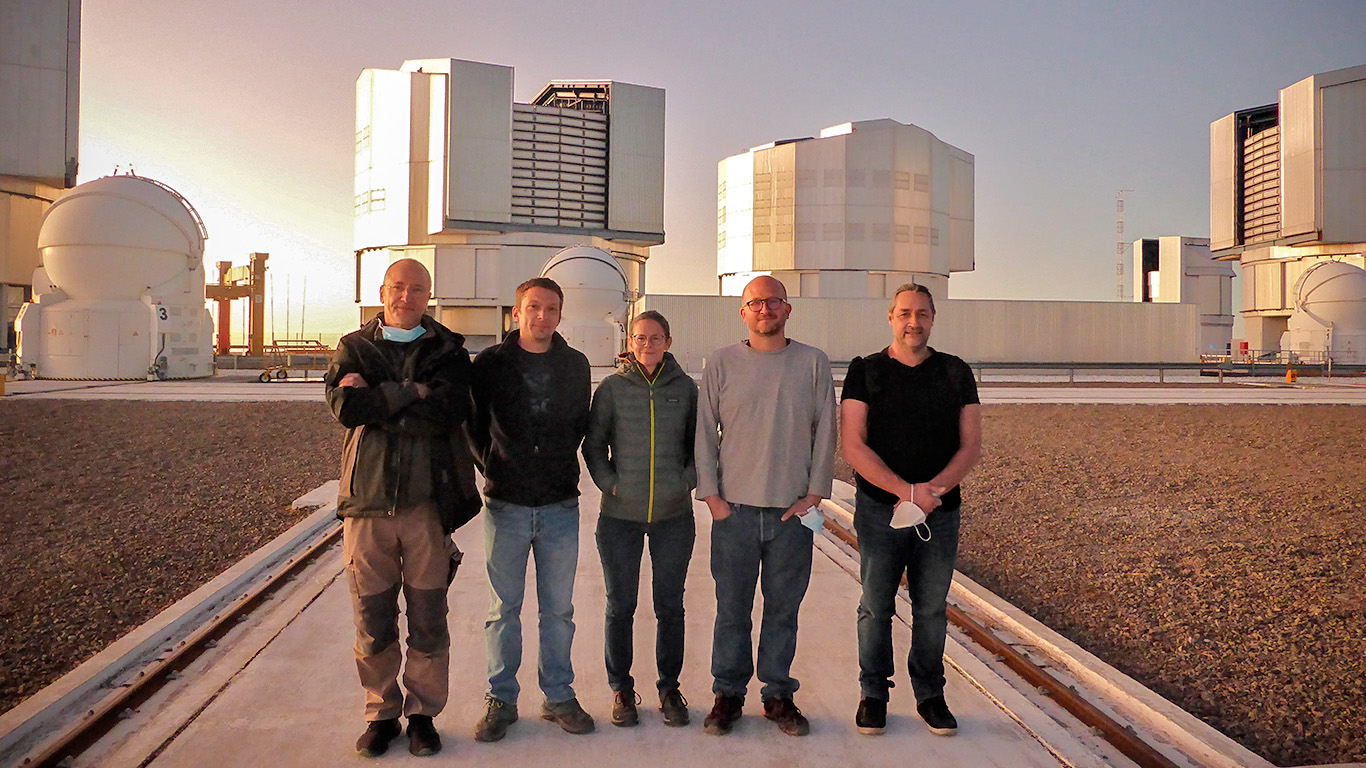
At Université Côte d’Azur in France, Dr. William Guerin, a researcher at the Centre National de la Recherche Scientifique (CNRS), is part of a team investigating cold atoms and light–atom interactions. Alongside this core research, his group initiated a long-term collaboration with astronomers to explore stellar intensity interferometry, a technique that measures correlations in light intensity to study the angular size and structure of stars.
Initially a side project, this work has grown into a major effort supported by a European Research Council (ERC) grant. To achieve the timing precision required for these measurements, the team relies on Swabian Instruments’ Time Taggers, which play a central role in their experiments.
The team’s objective is to detect very small photon correlation signals, so-called “bunching peaks”, embedded within a large statistical background. Such measurements demand extremely stable and precise time tagging.
Early experiments using conventional time-to-digital converters (TDCs) revealed significant issues. The instruments introduced spurious correlations caused by differential nonlinearity (DNL), small variations in bin width that created artificial patterns in the data. For the CNRS team, these artifacts masked the true physical correlations and made calibration both complex and unreliable.
“What we measure is a tiny bunching peak on a large background. We are very sensitive to any spurious correlations, and in standard TDCs this effect was simply too strong for us.”
In 2017, the team met representatives from Swabian Instruments, who introduced them to the Time Tagger platform. After explaining their challenges, the researchers learned that Swabian Instruments had recently addressed the DNL issue. The team received a Time Tagger for testing, and the results were decisive.
“We tested it and were very happy. At larger delays, there were no spurious correlations. That was a game-changer for our experiment.”
Encouraged by these results, the group integrated Swabian Instruments Time Taggers into their setup and later acquired four Time Tagger Ultras (TTUs) as part of their ERC-funded expansion.
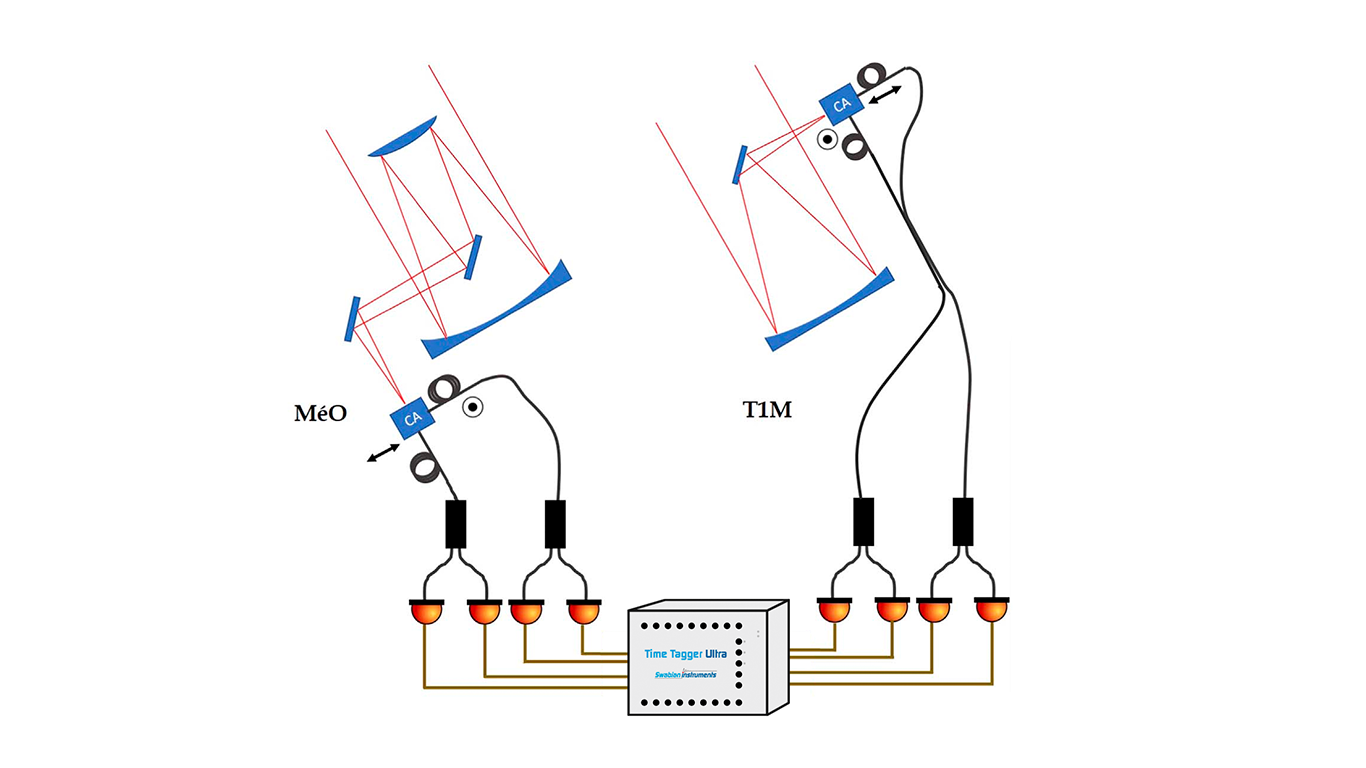
The research setup is based on intensity interferometry using two telescopes directed at the same target star. Instead of recombining light optically, which would require sub-wavelength stability across hundreds of meters, the team records photon arrival times electronically and performs cross-correlation analysis afterwards.
Early measurements used Single-Photon Avalanche Diode (SPADs) detectors with approximately 500 ps timing resolution, chosen for their balance between active area, efficiency, and timing performance. As the project progressed, the group upgraded to:
Swabian Instruments’ Time Tagger Ultras form the timing backbone of these setups. In one configuration, the team utilized eight detectors and computed twelve cross-correlations in real-time, enabled by Swabian Instruments’ software libraries.
“Your libraries are extremely useful and easy to use. We computed 12 correlations in real time with eight detectors; that’s impressive.”
By replacing legacy TDCs with Swabian Instruments Time Taggers, the CNRS group eliminated DNL-related artifacts at longer delays, achieving cleaner and more reliable correlation data. The improved accuracy and simplified workflow have significantly increased productivity and confidence in their results.
With new ERC funding, the team is now working on wavelength multiplexing, running parallel measurements across multiple spectral channels to improve sensitivity and study fainter astronomical targets. Swabian Instruments’ multi-channel, high-precision timing capabilities align perfectly with this direction.
A key scientific goal of the project is to achieve the first direct measurement of a white dwarf’s diameter, specifically Sirius B. To reach the required angular resolution, the group is developing an instrument for telescopes in Hawaii, where baselines extend up to 800 meters, potentially setting a new record in stellar intensity interferometry.
The collaboration continues to evolve. The team is investigating ways to minimize short-delay cross-talk effects and is exploring Swabian Instruments’ High-Resolution Mode for their latest detectors.

W. Guerin et al., “Stellar intensity interferometry in the photon-counting regime,” Comptes Rendus. Physique 26, 659 (2025); arXiv:2503.22446v2 [astro-ph.IM], Mar. 2025.
N. Matthews et al., “Intensity Interferometry observations of the Hα envelope of γ Cas with MéO and a portable telescope,” Astron. J. 167, 117 (2023); arXiv:2301.04878 [astro-ph.IM], Jan. 12, 2023.