
Single-Photon Timing for Photon-Pair Generation: The Time Tagger Ultra at LAAS
by Zeynab Tavakoli | on 17 September 2026
Researchers at LAAS in Toulouse generate correlated photon pairs in fiber Fabry-Perot resonators. The group uses the Swabian Instruments Time Tagger Ultra to count single photons from their SPAD detectors and to resolve the coincidences that confirm pair generation. The Time Tagger Ultra replaced an earlier low-cost digital acquisition card that was slow and complicated, simplifying the detection chain and giving the group a reliable photon-counting platform. Its precision was also key to characterizing the laser noise floor and validating the team's optical filtering, work the group is now preparing for publication.
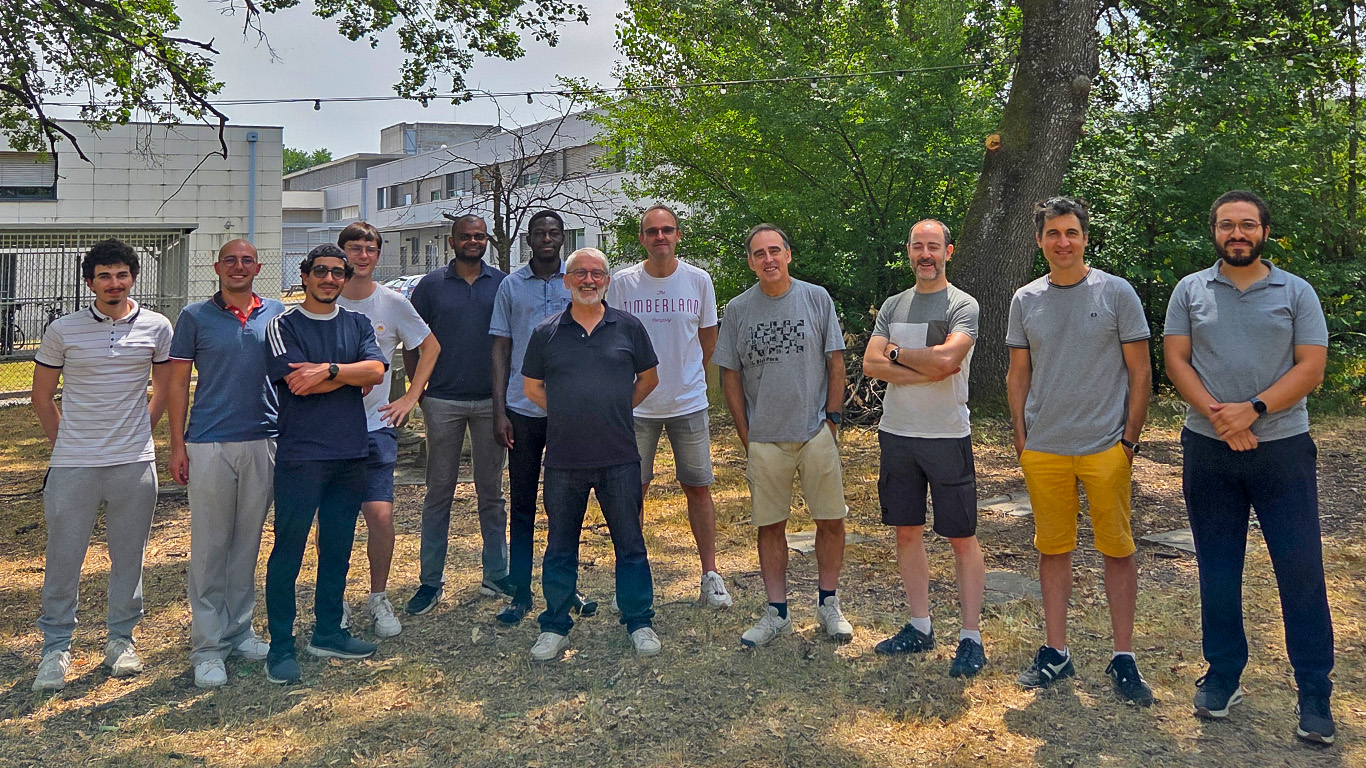
At the Laboratory for Analysis and Architecture of Systems (LAAS) in Toulouse, a group has recently moved into quantum photonics. The group brings a strong background in optical and microwave systems to a new line of work: the generation and characterization of correlated photon pairs for quantum applications.
Nassim Zaki first joined the group LAAS in 2024 for a six-month master’s internship, then began his PhD thesis with Olivier in November 2025. His thesis focuses on photon-pair generation, and the Time Tagger Ultra (TTU) sits at the center of his measurement chain.
The work uses fiber Fabry-Perot resonators and the third-order (χ³) nonlinearity to generate photon pairs through spontaneous four-wave mixing, with the pairs produced near 1550 nm on the resonance wavelengths of the cavity. The generated photons are detected with single-photon avalanche detectors (SPADs) and registered by the Time Tagger Ultra, which the group uses to count events and to measure the time correlations that confirm pair generation.
Resolving Photon Pairs Against the Laser Noise Floor
Photon-pair experiments operate at extremely low optical power. Each detected event carries very little energy, so any excess noise in the system directly competes with the signal of interest. For Nassim’s group, this constraint shaped a significant part of the experimental effort.
The pump laser was a recurring source of difficulty. The group changed lasers three times, because the early sources were not spectrally narrow enough and carried noise outside the intended laser band. This laser noise floor leaked into the detection window and degraded the measurements. To bring it under control, the team introduced a chain of optical filters, but filtering alone was not enough: they needed a way to quantify how much noise still passed through the filters and reached the detectors.
That required a detection instrument precise enough to characterize residual noise at the single-photon level and to resolve the narrow coincidence windows that distinguish genuine photon pairs from accidental counts.
Why LAAS Chose the Time Tagger Ultra
The group selected the Time Tagger Ultra in part because several colleagues working in Toulouse already use Swabian Instruments hardware. They were looking for an instrument they could trust, and the TTU delivered exactly that.
It is the first dedicated photon-counting instrument the group has owned. Their earlier approach relied on a low-cost digital acquisition card, which proved ineffective: it was workable only at low speeds and made the measurement chain more complicated than necessary. Replacing it with the Time Tagger Ultra simplified the entire receiver side of the experiment.
“I wanted something reliable. With the Time Tagger, everything has been simplified on the receiver.”
— Olivier Llopis, Research Director, LAAS
Inside the Measurement Setup
In the experiment, the SPAD outputs feed directly into the Time Tagger Ultra, and the group runs two core measurement types. The first is an independent count measurement on each channel, used to monitor the photon rate from each detector. The second is a coincidence measurement that identifies photons arriving in the same time bin in both channels. These coincidences are the signature of correlated photon pairs, and resolving them cleanly is what allows the group to confirm pair generation and study the quality of their source.
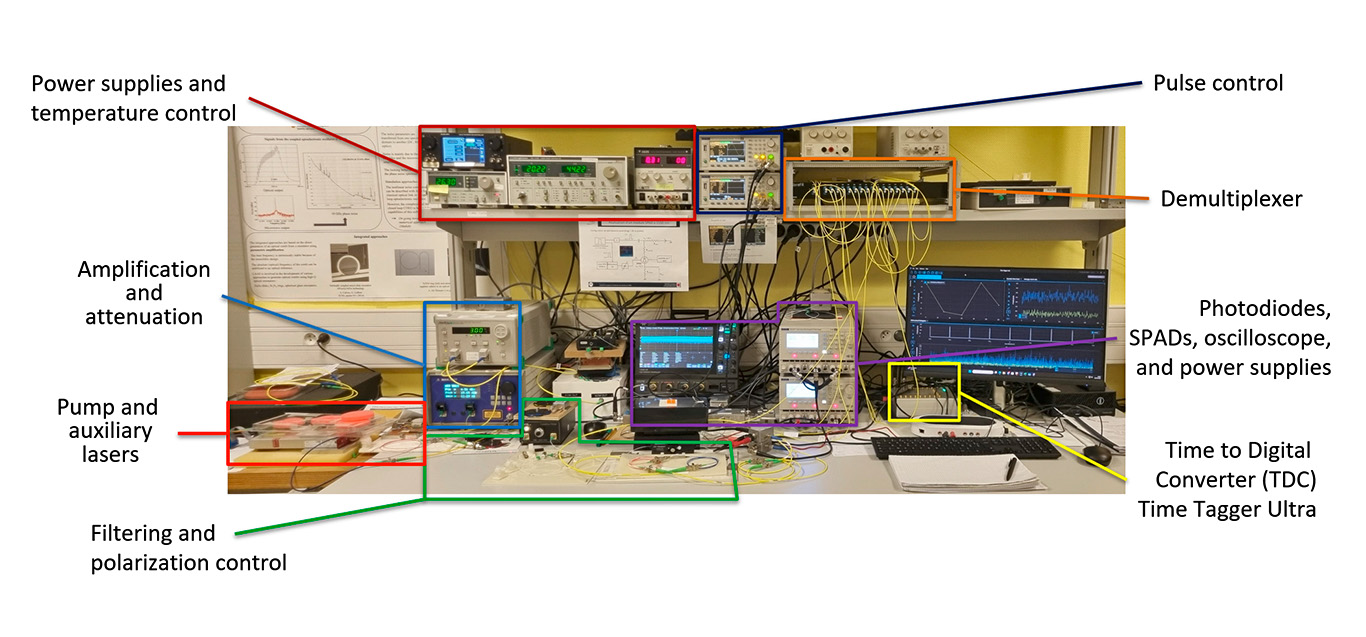
The team uses the instrument in two complementary ways. For quick checks, they work directly through the graphical interface. For longer, automated runs, Nassim drives the Python API, which lets him sweep parameters over extended acquisition times and coordinate the measurement with the rest of his setup. That setup includes an oscilloscope for monitoring the pulses at the output of the resonator, a function generator for modulating the detection and generation timing, and a Moku FPGA platform used to stabilize the laser. Controlling all of these instruments from a single Python environment, with the Time Tagger Ultra acquiring the photon-counting data, gives the group a flexible and repeatable workflow.
The Time Tagger Ultra removed a major source of complexity from the experiment. Where the earlier digital-card approach was limited, the TTU streamlined the detection chain and gave the group a reliable foundation to build on. Its precision was central to diagnosing the laser noise problem: the team used the SPADs to measure the laser floor, evaluate the effect of their filtering, and confirm how much residual noise still reached the detectors. With the noise understood and the coincidences cleanly resolved, the group is now preparing its results for publication.
Quantum photonics is a young and growing activity at LAAS. The field is gaining interest across the laboratory and among its partners in Toulouse, and Olivier’s group expects this direction to expand. As it does, reliable single-photon timing remains a core requirement, and the Time Tagger Ultra continues to support that work.