SPIE Photonics Europe 2026: The premier European optics and photonics research and development event
by Zeynab Tavakoli | on 23 April 2026
SPIE Photonics Europe 2026 in Strasbourg brought together the optics and photonics community for a week of scientific exchange, innovation, and networking. Swabian Instruments showcased its solutions and connected with researchers and industry professionals from across Europe.
SPIE Photonics Europe 2026, held in Strasbourg, France from April 12–16, is one of the leading photonics conferences in Europe. The event brings together researchers, engineers, and industry professionals to explore the latest developments in optics, quantum technologies, imaging, and sensing.
This year’s conference combined scientific talks, poster sessions, and a busy exhibition floor, creating a strong platform for both knowledge exchange and collaboration. Swabian Instruments was part of the exhibition, where we connected with the community, showcased our solutions, and explored new ideas shaping the future of photonics.
SPIE Photonics Europe is known as a key meeting point for the photonics community. The event covers a wide range of topics, from quantum technologies and optical imaging to biophotonics and advanced materials.
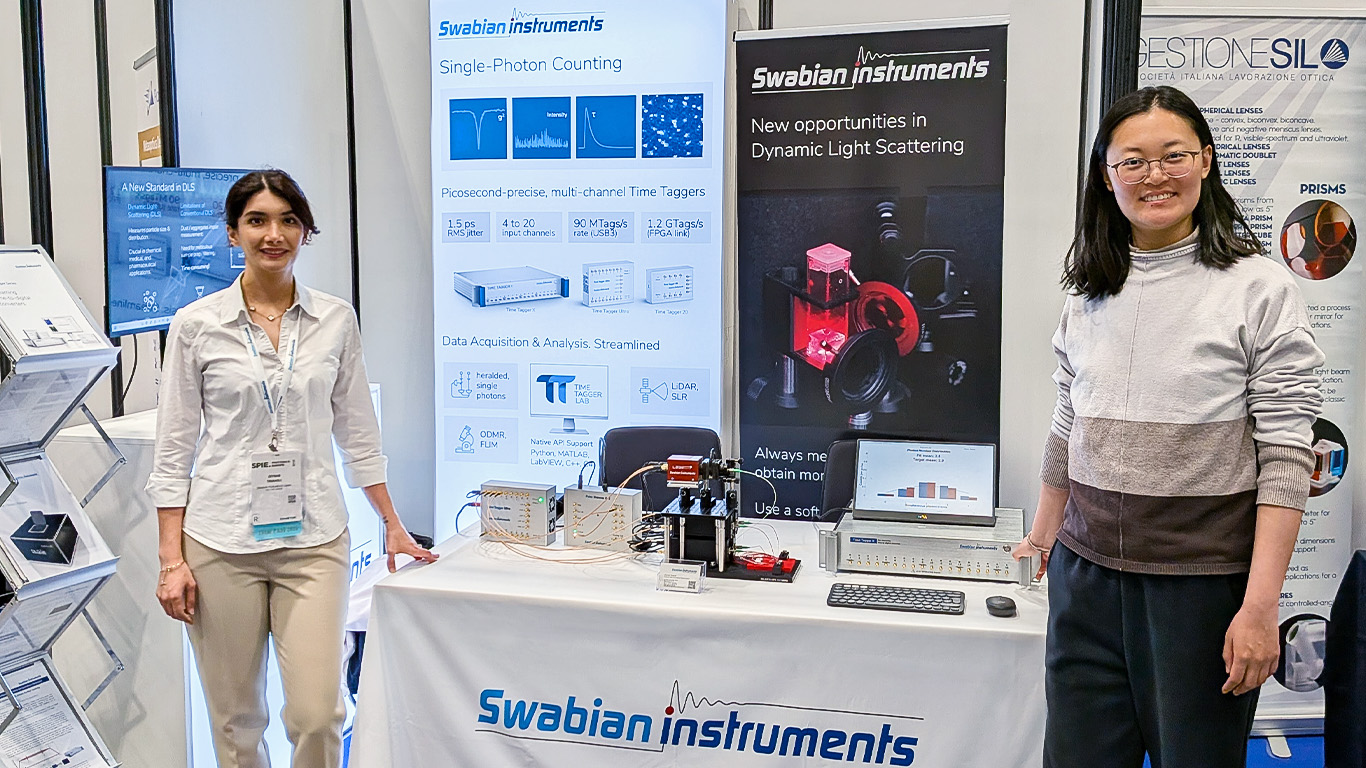
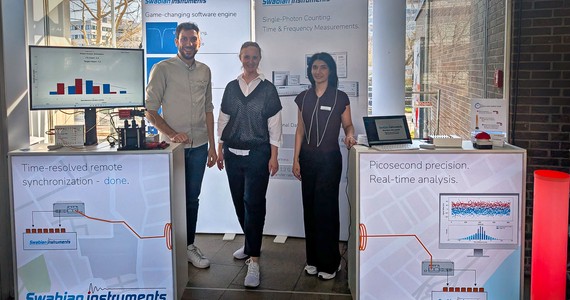
At the exhibition, Swabian Instruments presented our Pulse Streamer and Time Tagger, using a Pseudo Photon Number Resolution demo setup. Visitors had the opportunity to explore our this experiment, which included an interactive element to enhance the experience. More details about the demo and setup can be found on our DPG SAMOP 26 highlight post.
Throughout the event, we had many valuable conversations at the booth, ranging from technical questions to new application ideas, reflecting the broad interest in high-performance photonic measurement solutions. One of the most valuable aspects of SPIE Photonics Europe was the continuous exchange of ideas, both at the booth and through insights from talks and poster sessions, which deepened understanding of current trends and challenges in the field. The event also highlighted the continued growth and impact of the photonics industry, with applications spanning research, healthcare, manufacturing, and beyond. These interactions play an important role in shaping future developments and strengthening collaborations across the community.
Photonic Research Powered by Swabian Instruments
A particularly rewarding part of the conference was seeing researchers present their work using our instruments. It is always exciting to see how our technology supports real-world experiments and advances scientific discovery.
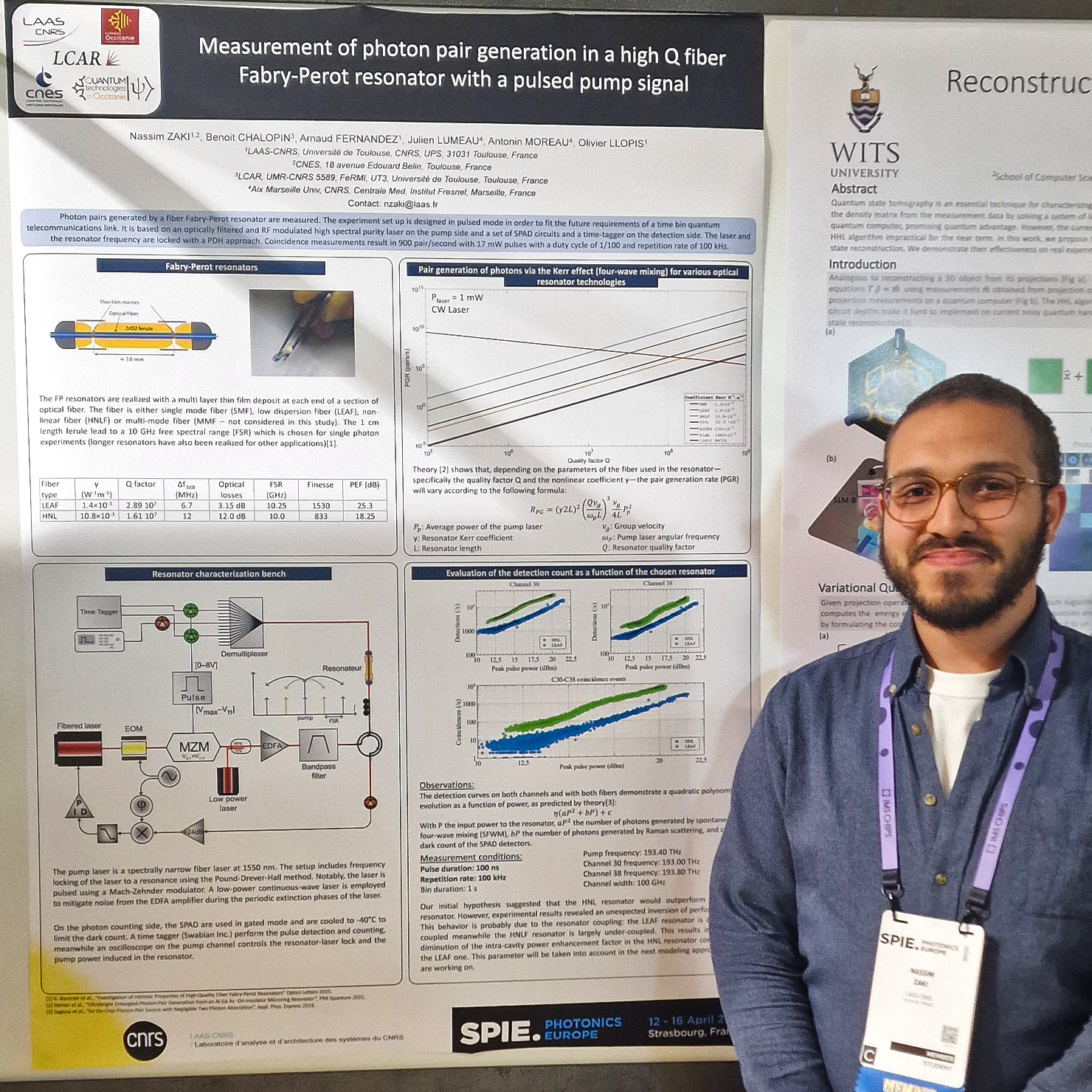
Nassim Zaki (Université de Toulouse, CNRS, France): Measurement of photon pair generation in a high-Q-fiber Fabry-Perot resonator with a pulsed pump signal
Nassim investigated photon-pair generation in a fiber Fabry-Perot resonator using a pulsed pump setup designed for future quantum communication systems. By performing coincidence measurements with SPAD detectors and a Time Tagger Ultra, his work provides insights into efficient photon-pair generation for time-bin quantum networks.
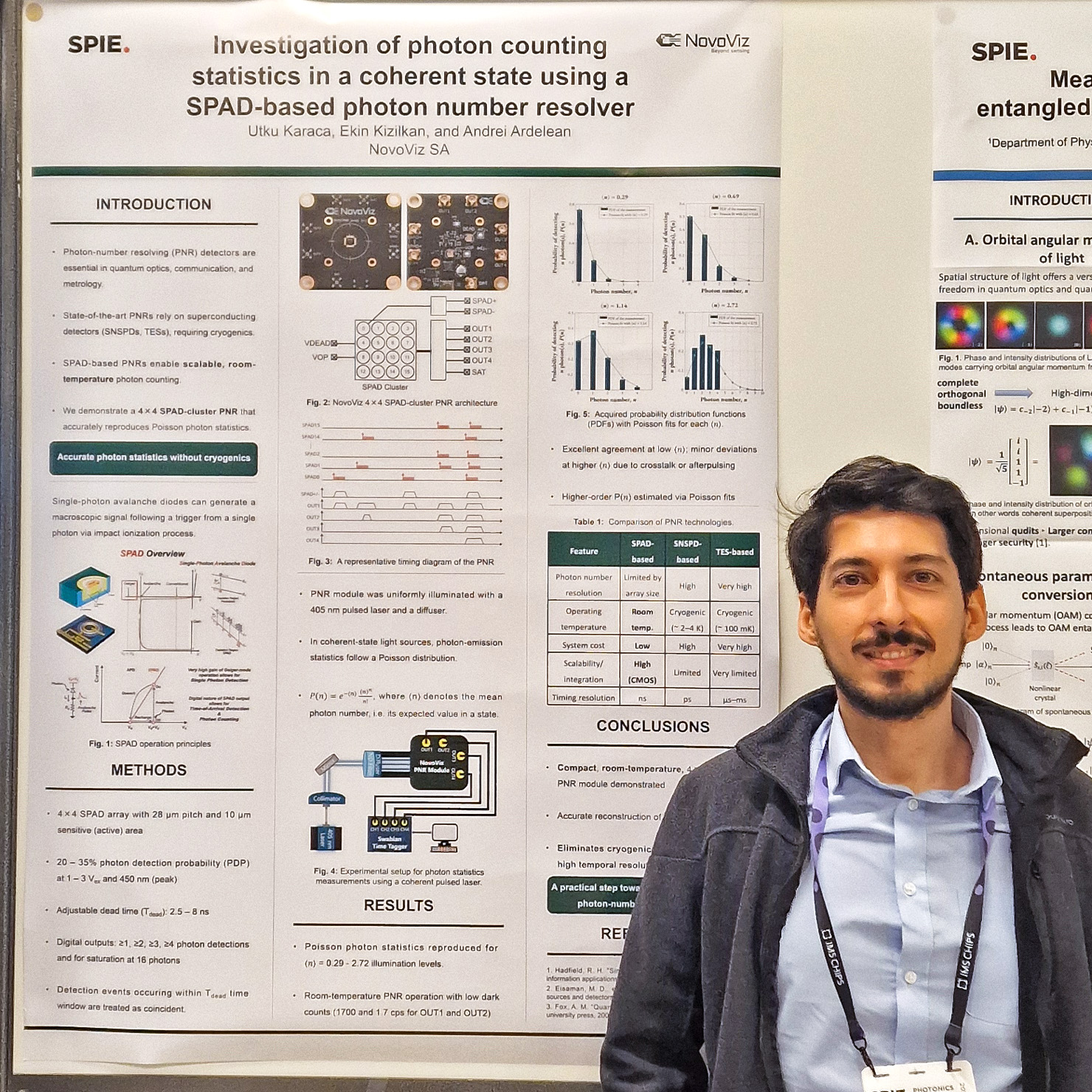
Utku Karaca (NovoViz SA, Switzerland): Investigation of photon counting statistics in a coherent state using a SPAD-based photon number resolver
Utku presented a compact, room-temperature photon number resolving system based on a SPAD array, demonstrating accurate reconstruction of photon statistics from a coherent light source. Using a Time Tagger Ultra for precise timing and data acquisition, his work highlights a practical and scalable alternative to cryogenic photon detectors for quantum optics and measurement applications.

Sara Klopčič (Jožef Stefan Institute & University of Ljubljana, Slovenia): Entanglement tuning and quantum imaging in liquid crystal structures
Sara demonstrated how ferroelectric nematic liquid crystal structures can be used to tune photon-pair entanglement and enable quantum imaging. Using a Time Tagger Ultra for precise photon correlation measurements, she controlled entanglement with external electric fields and explored complex geometries, opening new possibilities for imaging and characterizing structured materials using quantum light.
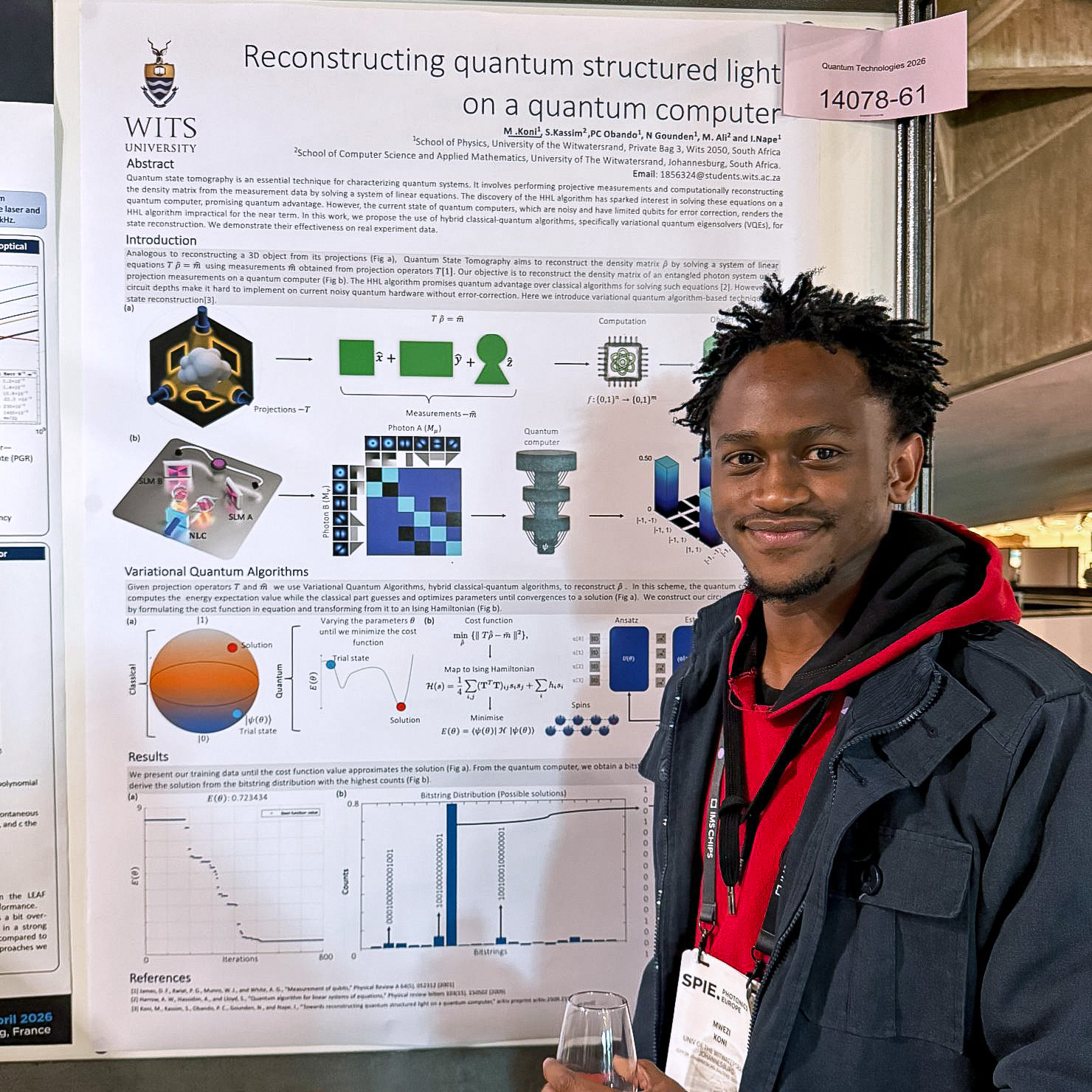
Mwezi Koni (University of the Witwatersrand, South Africa): Reconstructing quantum structured light on a quantum computer
Mwezi explored quantum state tomography using hybrid classical-quantum algorithms, specifically variational quantum eigensolvers (VQEs), to reconstruct quantum states from experimental data. Using a Time Tagger Ultra Performance for accurate photon timing and data collection, his work demonstrates how quantum computing methods can be applied to better understand and process complex structured light fields.
SPIE Photonics Europe 2026 once again proved to be an important event for the photonics community. The combination of scientific exchange, industry presence, and networking opportunities made it a valuable experience for everyone involved.
For Swabian Instruments, the conference was a great opportunity to showcase our solutions, connect with users, and see how our instruments are being used in cutting-edge research. We look forward to continuing these conversations and meeting the community again at future events.
Related Content
Photon Number Resolution (PNR)
Photon number resolution (PNR) is an enabling technique used to assign the number of photons involved in a detection event precisely.