DLS for Food Colloids: Handling Complex Samples
by Catherine Cruz Luukkonen | on 04 November 2026
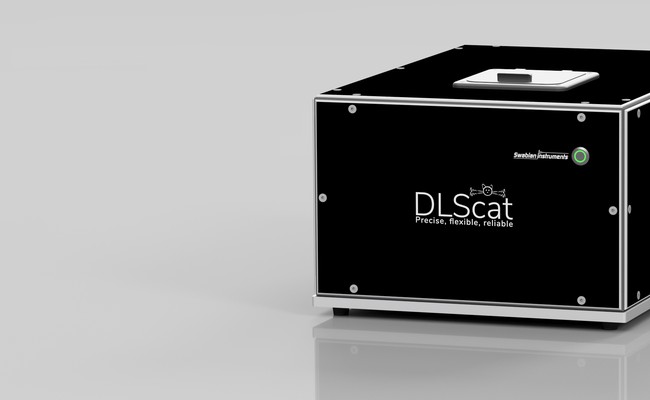
Swabian Instruments attended the 20th Food Colloids conference in Granada for the first time, presenting our Dynamic Light Scattering system to researchers from around the world, and it sparked some interesting conversations around how our system is well suited to deal with complex samples, because of features such as multi-angle DLS or spike filtration.
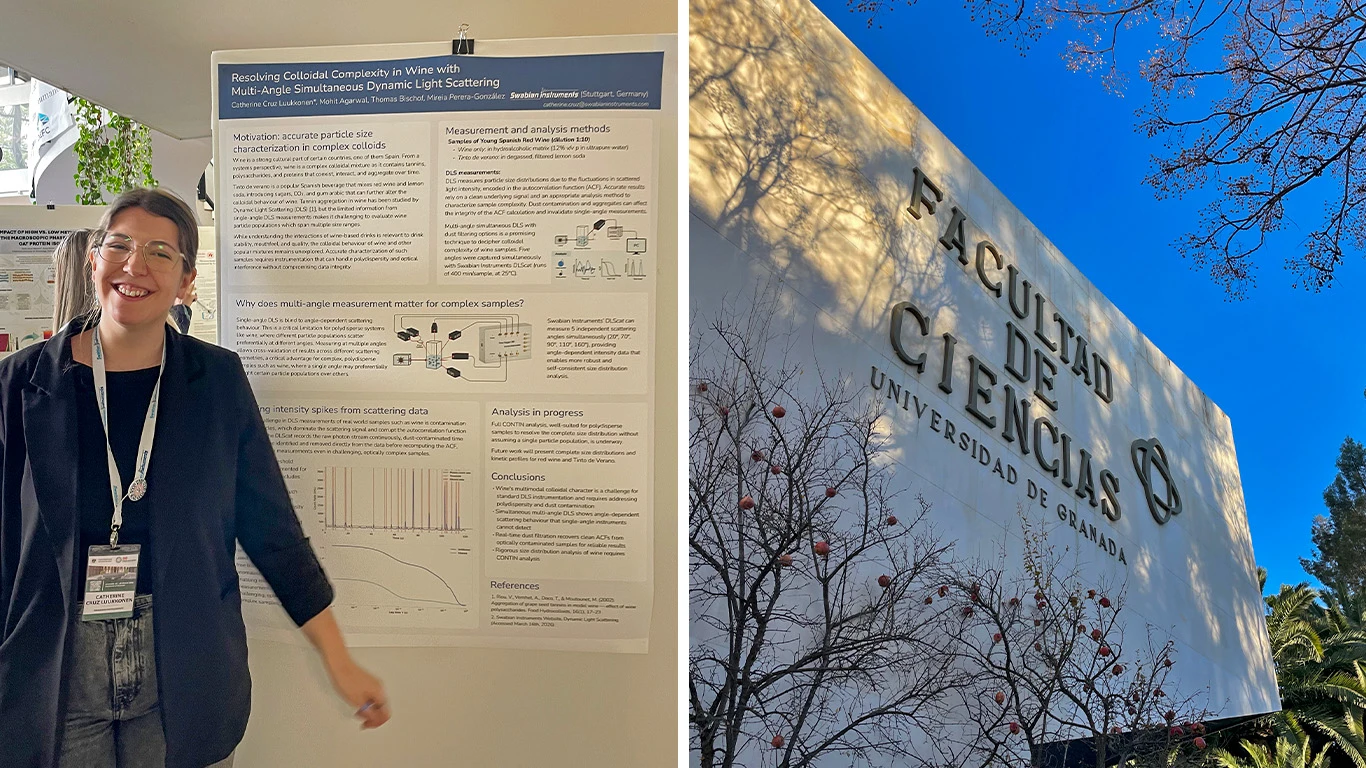
Food colloids such as emulsions, foams, and protein gels are polydisperse, change over time and are often highly concentrated, which makes them demanding samples for dynamic light scattering (DLS). Swabian Instruments presented its multi-angle DLS system, the DLScat, at the 20th Food Colloids Conference in Granada, 22 to 26 March 2026. The conference has been held every two years since it started in Leeds in 1986. The poster session led to many discussions about how DLS can handle food colloid samples and about the measurement challenges researchers in this field face.
Why are food colloids difficult samples for DLS?
Most food colloids contain several particle populations at once, so a single size value does not describe them. Many changes occur during the measurement through aggregation or phase separation. Many are concentrated enough that multiple scattering distorts the signal. Dust and large aggregates add intensity spikes on top. A single-angle DLS measurement averages all of this into a single correlation function, losing detail. Multi-angle measurement, kinetics tracking, and spike filtering address these problems separately.
How does the DLScat handle food colloid samples?
Our poster showed how the DLScat addresses each of these problems. The conversations it started are summarized below.
- Simultaneous multi-angle measurements
One of the features that drew the most attention was our system’s ability to perform simultaneous multi-angle DLS measurements, recording data from 5 angles simultaneously. This capability is particularly powerful for complex food colloid samples, where single-angle measurements can miss critical information about particle size distributions and sample heterogeneity. Additionally, the ability to track the kinetics of samples over time proved to be of great interest, especially for researchers studying aggregation dynamics and stability. An example is in our application note on measuring multi-modal particle sizes with the DLScat. - Filtering intensity spikes from scattering data
Another highlight of our device was our approach to filtering intensity spikes from scattering data. In real-world food colloid samples, dust, aggregates, or other contaminants can introduce misleading artifacts into DLS measurements. Our solution provides robust tools to identify and remove these spikes, ensuring cleaner, more reliable data, a feature that experts in the room immediately recognized as highly practical for their daily work. - Temperature-controlled measurements
With a measurement range of 16 °C to 100 °C and step increments of 0.1 °C, the DLScat enables the study of particle behavior across the full spectrum of food processing and storage conditions. - High-concentration tolerance
The DLScat can handle highly concentrated systems commonly found in real food products.
Conclusion
Attending the Food Colloids conference for the first time was a rewarding experience for the Swabian Instruments team. Granada provided a meaningful scientific exchange, and the conversations that emerged from our DLS poster made it clear that there is a strong and growing need for precise, flexible measurement tools in the field of food colloids. From simultaneous multi-angle DLS measurements to robust spike filtering capabilities, our system is designed to meet these demands, and we look forward to continuing to explore ways we can support future research in the field of food colloids.
Interested in seeing our DLS system in action? Reach out to our team to discuss your samples directly at solutions@swabianinstruments.com
Interested in seeing our DLS system in action? Reach out to our team to discuss your samples directly at
Related content
DLScat