
Material Research Society (MRS) Fall Meeting 2025: Time-Resolved Spectroscopy, Lifetime Measurements, and Multi-Angle Dynamic Light Scattering at the Swabian Instruments & ISS Booth
by Yizhou Wang | on 24 April 2026
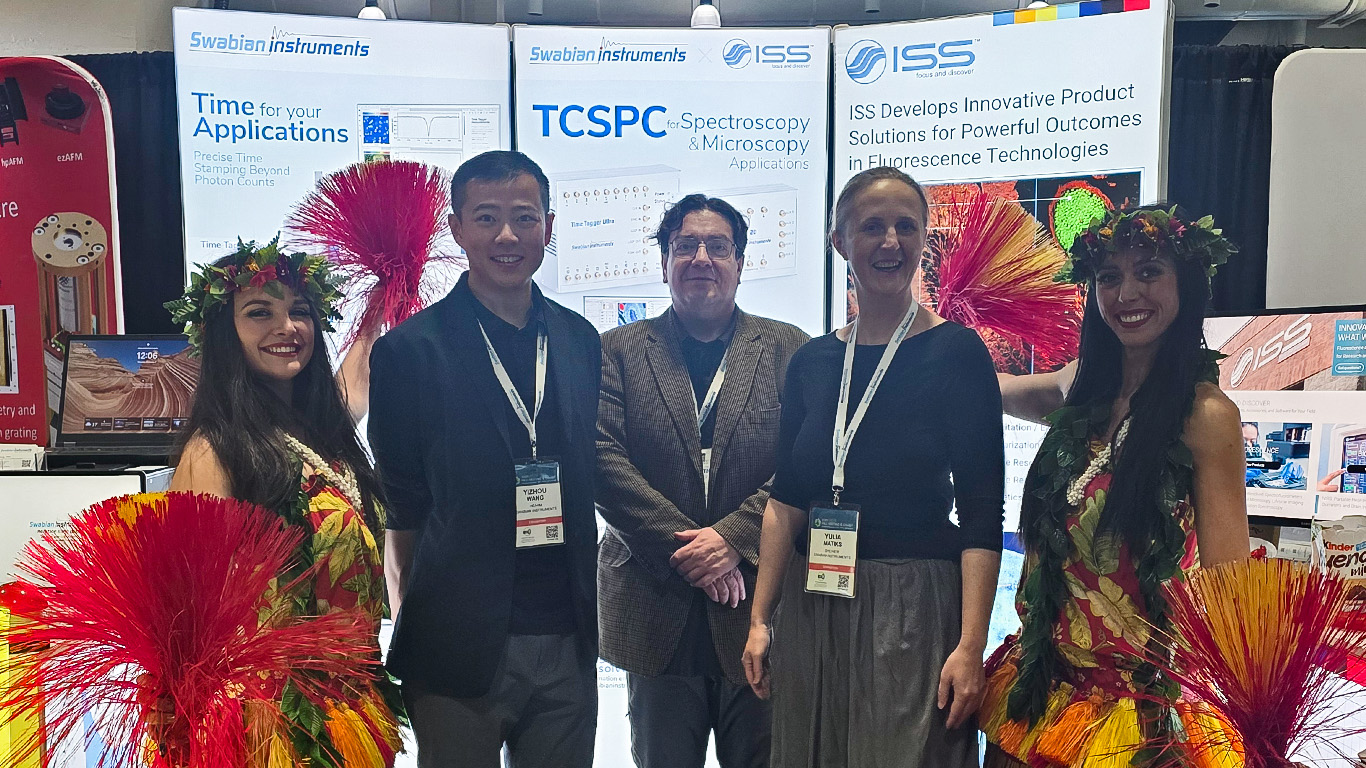
At the MRS Fall Meeting 2025 in Boston, Swabian Instruments and ISS jointly showcased advanced time-resolved measurement solutions, including Time Tagger, Pulse Streamer, and DLScat. The booth featured live demonstrations of lifetime measurements using Time Tagger and real-time particle dynamics analysis using Dynamic Light Scattering, drawing strong interest from the materials research community.
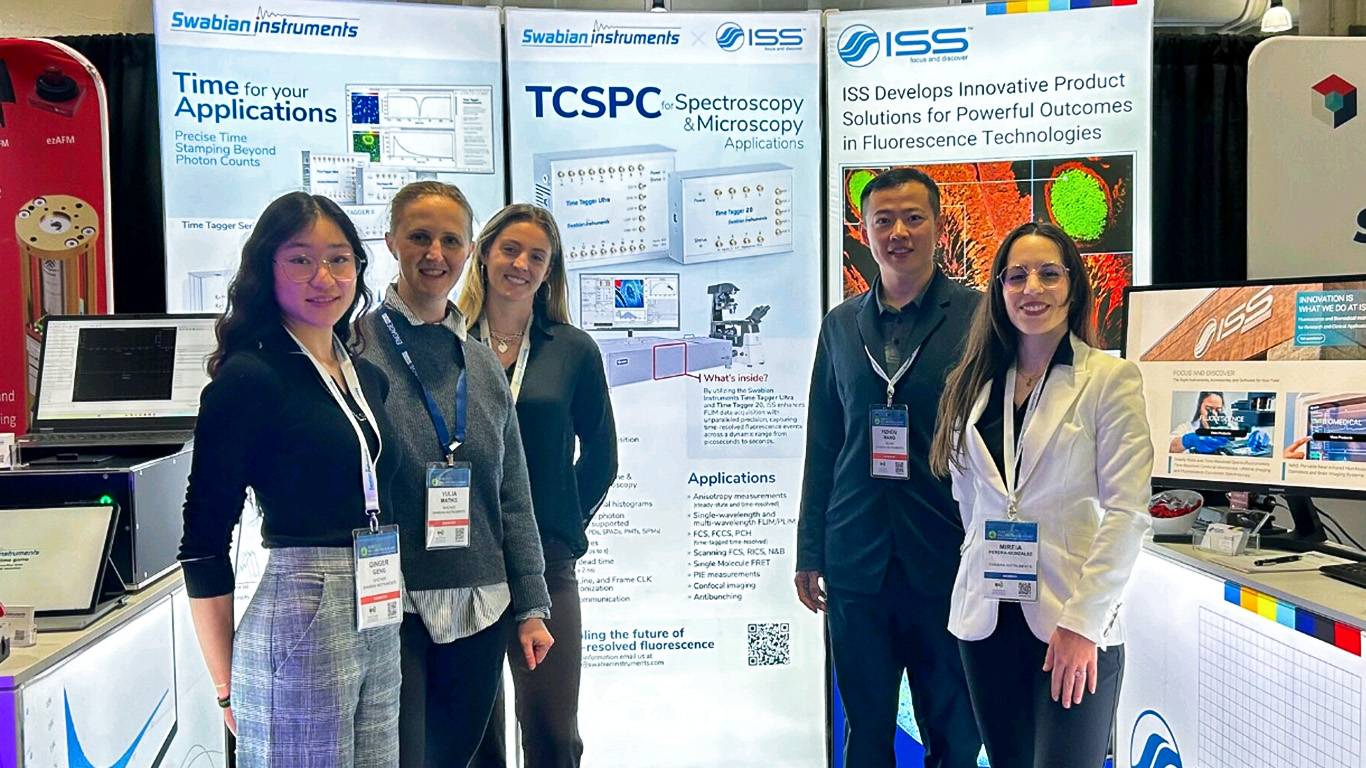
The Materials Research Society Fall Meeting 2025 in Boston once again brought together the global materials research community to discuss the latest advances in materials characterization, spectroscopy, and nanoscale dynamics. This year, Swabian Instruments exhibited together with ISS, highlighting a shared focus on time-resolved spectroscopy, fluorescence lifetime measurements, and Dynamic Light Scattering (DLS).
At the booth, we presented our timing and waveform-generation solutions, including the Time Tagger series, the Pulse Streamer, and our particle size analyzer, DLScat. Throughout the week, we had many in-depth discussions with researchers working on photoluminescence (PL), Raman spectroscopy, fluorescence lifetime measurements, and particle dynamics in complex materials systems.
Photoluminescence and Fluorescence Lifetime Measurements
Many researchers at MRS were especially interested in photoluminescence and fluorescence lifetime measurements for materials characterization. These discussions were particularly relevant for researchers working on semiconductors, nanomaterials, and biomaterials, where lifetime information can provide insight beyond conventional steady-state measurements. In these contexts, fluorescence and photoluminescence lifetimes are valuable for understanding emission dynamics, recombination behavior, and other fast optical processes that are not captured by spectral information alone.
To illustrate this in a practical, accessible way, we presented a fluorescence lifetime demonstration at the booth. The demo made the measurement concept highly visual and intuitive, allowing visitors to see directly how lifetime data can be acquired and interpreted in real time. It also highlighted the usability of our software interface, showing how users can work with lifetime measurements in a straightforward way without needing to navigate an overly complex workflow.
Interest in Time-Gated and Time-Resolved Raman
At MRS, one of the clearest themes in our Raman-related conversations was the strong interest in time-resolved Raman approaches. Many researchers were dealing with material systems where conventional Raman measurements are limited by strong photoluminescence background, weak Raman features, or the need to distinguish fast optical processes that overlap spectrally. In these discussions, it became clear that adding temporal information to Raman spectroscopy is increasingly seen not only as a way to improve contrast but also as a path toward extracting richer insight from complex materials systems.
These conversations also highlighted how Swabian Instruments can help enable time-resolved Raman measurements in practice. For this type of experiment, the most important requirements are high temporal precision, low timing jitter, and reliable compatibility with a range of detector technologies. In addition, intuitive software is critical for making these measurements more accessible, especially for users who want to evaluate timing performance, build histograms, and interpret photon arrival data without an overly complex workflow. From this perspective, Swabian Instruments offers a practical foundation for researchers interested in implementing time-resolved Raman methods.
DLScat: Multi-Angle, Real-Time Dynamic Light Scattering
Our Dynamic Light Scattering system, the DLScat, also attracted strong interest from researchers working on colloids, polymers, soft matter, and complex fluids. Many of these discussions focused on the value of real-time, multi-angle DLS for studying systems whose behavior evolves over time. Researchers were particularly interested in the ability to directly observe particle dynamics and aggregation processes in real time, while simultaneously acquiring multi-angle data to build a more complete picture of complex systems.
MRS Fall Meeting 2025 in Boston was a highly successful event for Swabian Instruments. From the joint booth with ISS and the strong interest in Time Tagger–based lifetime and TCSPC spectroscopy, to the first public debut of DLScat, the week was filled with deep technical conversations and new connections across the materials science community.
We would like to thank everyone who stopped by the booth to discuss their experiments, challenges, and ideas. We look forward to continuing these conversations and supporting the next generation of time-resolved, dynamic materials characterization.
Related Content
Fluorescence Lifetime Imaging (FLIM)
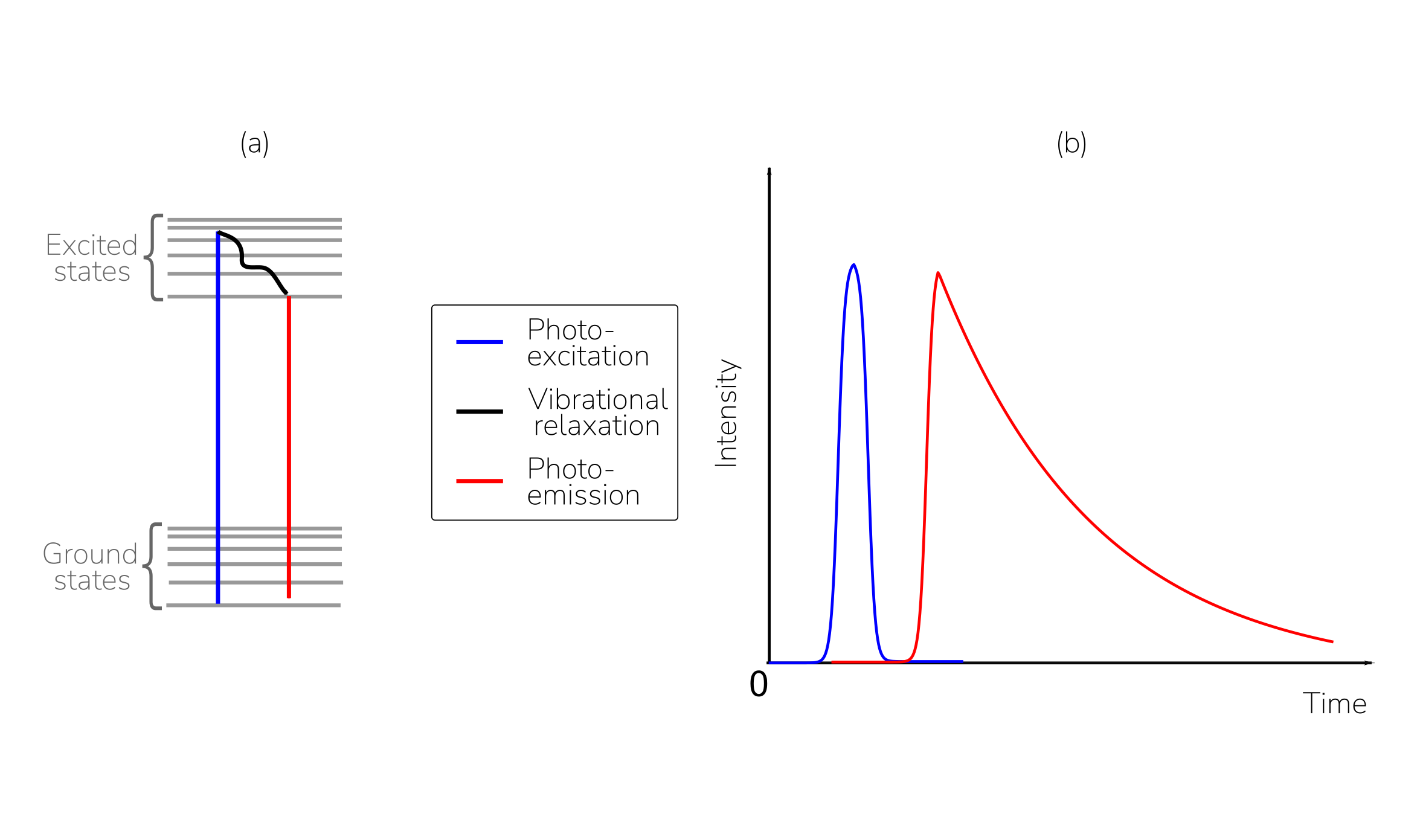
Discover fluorescence lifetime imaging (FLIM), a powerful imaging technique for mapping fluorescence lifetimes with picosecond precision. Learn how Swabian Instruments' Time Taggers enable high-resolution FLIM measurements using advanced timing electronics, supporting detectors like PMTs, SPADs, and SNSPDs for cutting-edge research applications
Dynamic Light Scattering (DLS) Particle Size Analysis
Next-generation multi-angle DLS turnkey design with built-in consistency checks, raw photon access, and intelligent spike filtering for fast, reliable particle sizing.
