
ETH Zürich Advances Quantum Photonics with Swabian Instruments' Time Taggers
by Zeynab Tavakoli | on 10 June 2026
Researchers at the ETH Zürich generate time-bin entangled photon pairs on lithium niobate chips. With sub-nanosecond time-bin separations, Swabian Instruments' Time Tagger delivered the precision, automation, and visualization capabilities required by their experiments.
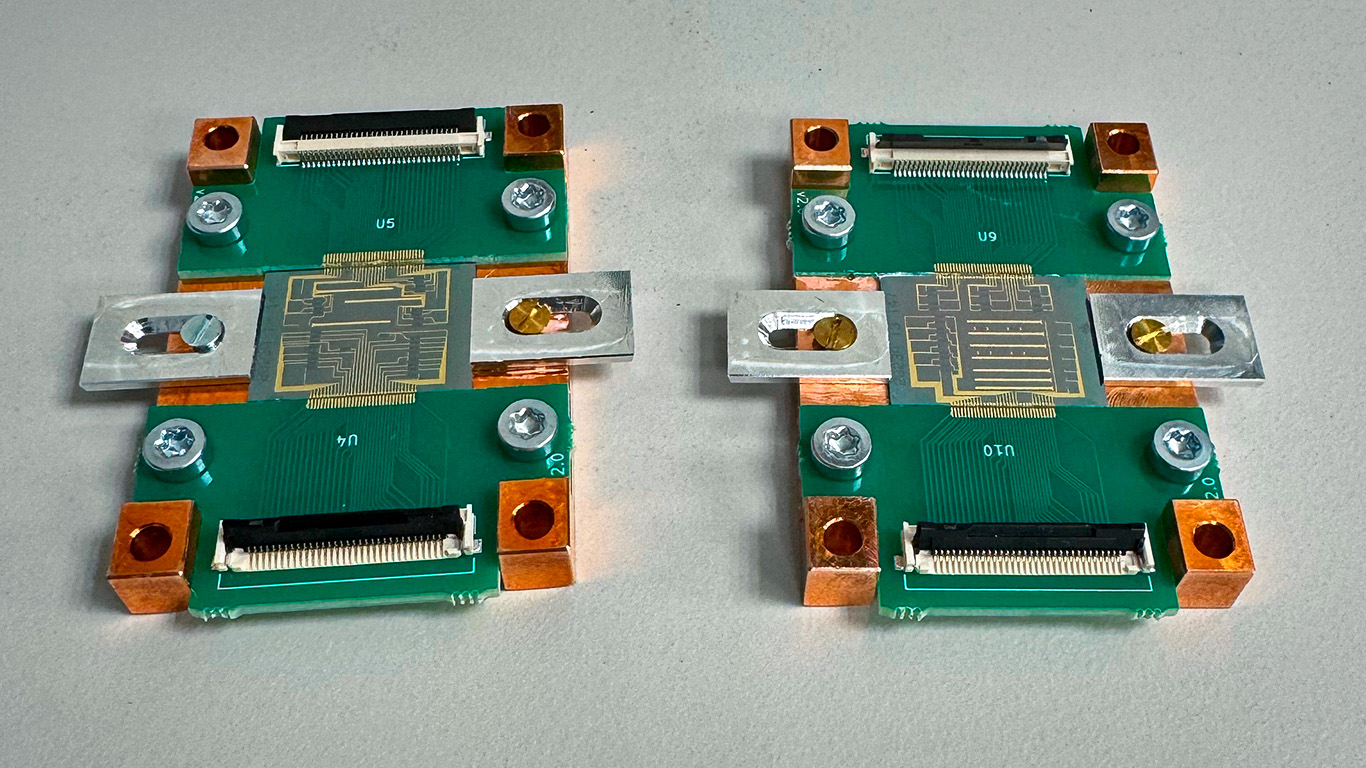
Prof. Rachel Grange leads a research group at ETH Zürich focused on building quantum photonic integrated circuits using the lithium niobate on insulator (LNOI) platform, a material that combines strong nonlinear optical properties with the ability to integrate many optical components on a single centimeter-scale chip.
The group’s focus areas include photon correlation analysis and quantum computing. Their experiments involve generating pairs of entangled photons at 1550 nm, the standard telecom wavelength for low-loss transmission over optical fibers, using spontaneous parametric down-conversion (SPDC). In a recent publication in npj Quantum Information 1, the team demonstrated the generation and tomography of time-bin entangled Bell states on a lithium niobate chip, marking an important step toward practical experimental setup. At the heart of these experiments is Swabian Instruments’ Time Taggers, which handles the precise timing and correlation measurements the work depends on.
The Challenge and The Solution: Time Tagger at the Core of the Setup
Time-bin entanglement encodes quantum information in the arrival time of photons, specifically, whether a photon arrives in an “early” or “late” time slot. In setup developed by Dr. Robert Chapman and Dr. Giovanni Finco, these two time bins are separated by just 220 picoseconds. To reliably distinguish them, every part of the detection chain needs to be fast and precise.
The team uses a pulsed 775 nm laser as both the pump for photon pair generation and as a timing reference. The generated photon pairs at 1550 nm are detected by superconducting nanowire single-photon detectors (SNSPDs). Any timing uncertainty from the detectors, the clock signal, or the time tagger accumulates and can make it impossible to separate the early and late time-bin events.
Beyond raw timing precision, the group uses 16 SNSPDs distributed across 6 parallel experiments to automate complex measurement routines, and keep data rates manageable when working with high-speed clock signals.
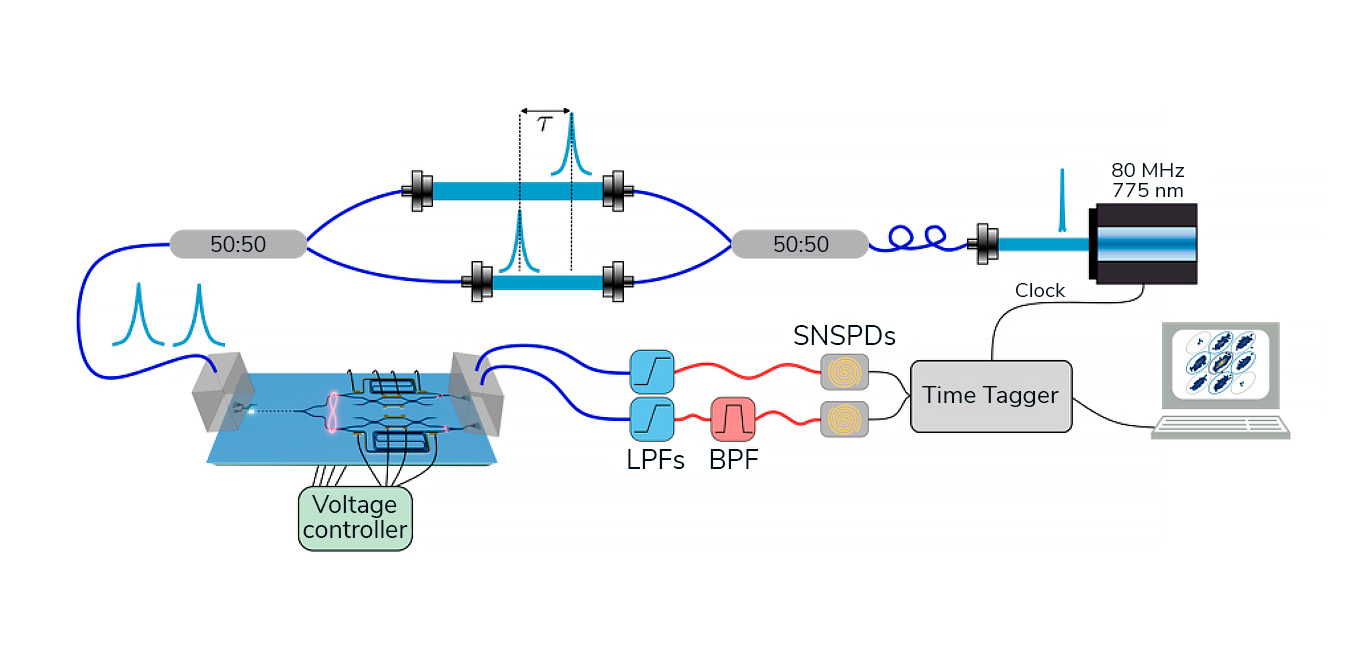
Dr. Chapman and Dr. Finco integrated Swabian Instruments’ Time Tagger Ultra and Time Tagger X into their lab. The Time Tagger’s low timing jitter meant it did not introduce significant uncertainty into their measurements, a critical requirement when working with 220 ps time-bin separations. The setup works as follows: the pulsed pump laser serves as a timing clock. Fiber optic components split the laser pulses to define time-bin qubits, which are then coupled into the lithium niobate chip. The generated photon pairs are filtered and routed to SNSPDs, and all detection events are recorded by the Time Tagger with sub-nanosecond resolution.
How Time Tagger Made a Difference: Visualizing the full quantum state
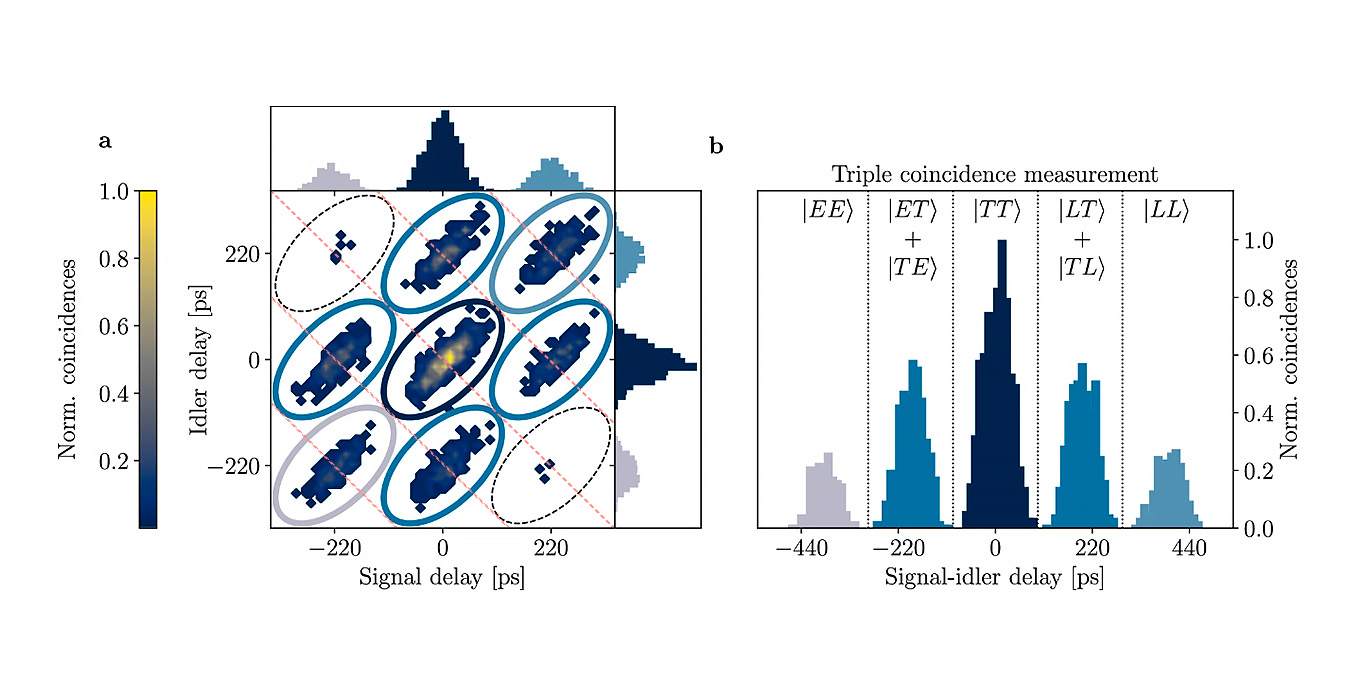
One of the most useful features for the ETH team was the 2D histogram capability. Standard triple-coincidence measurements can miss certain correlations because they collapse the data into a single dimension, leading some events to overlap and become indistinguishable.
As Dr. Chapman explained:
“The 2D histogram feature of the TT allowed us to visualize the complete two-qubit state and to distinguish all the possible experimental outcomes that are governed by probabilistic photon splitting.”
By visualizing coincidence events in two dimensions, signal and idler photon arrival times both referenced to the pump clock, the team could see the full structure of the quantum state at once, and then extract any one-dimensional projection they needed for comparison with other works. Using the Time Tagger, the team successfully generated and characterized time-bin entangled Bell states on a lithium niobate photonic chip, a result published in npj Quantum Information in 2024 and a follow up experiment was presented at CLEO Europe in 2025 2. The 2D histogram measurements provided a complete picture of the quantum correlations, going beyond what is typically reported in similar experiments.
The 2D histogram feature is also central to measuring the joint spectral intensity (JSI) of photon-pairs generated by SPDC. In the group of Prof. Grange, several experiments have exploited this approach using dispersive optical fiber and low loss photon detection to record the JSI with high precision 3 4.
Running parallel, automated experiments
The group operates 16 SNSPDs across 6 different experiments simultaneously. The Time Tagger Server feature allows multiple experiments to share access to the same instrument over the network, removing the bottleneck of having to dedicate hardware to a single setup. The team also built automated control routines using the Time Tagger’s Python API. These routines simultaneously drove the on-chip optical phase shifters via custom electronics and recorded triple-coincidence photon events, enabling long, fully automated measurement runs without manual intervention. Another key capability was conditional filtering: the Time Tagger can filter time tags based on whether specific events occur, which significantly reduces the data rate when using high-speed clock signals. As Dr. Chapman noted:
“The possibility of conditional filtering based on the occurrence of certain events allows us to reduce the data rate, which can easily diverge when using high-speed clock signals. Hence, it allows us to run experiments in parallel without risking compromising another measurement in case of overflow. The implemented functions enable sophisticated measurements that would be more complicated when handling time stamps by oneself.”
The combination of low jitter, network sharing, Python programmability, and conditional filtering allowed the group to run complex, multi-experiment workflows that would have been significantly harder to manage otherwise. The group is now continuing this work, with plans to develop a prototype system based on their recent publication results, which they intend to test on deployed fiber networks, a significant step toward real-world infrastructure.
“The Time Tagger is highly programmable, intuitive to use, and supports our parallel, automated experiments. We recommend it to any lab working with high-speed quantum photonics.”
References
Finco, G., Miserocchi, F., Maeder, A. et al. Time-bin entangled Bell state generation and tomography on thin-film lithium niobate. npj Quantum Inf 10, 135 (2024). https://doi.org/10.1038/s41534-024-00925-7 ↩︎
Finco, G. et al. An Integrated Photonic Circuit on Thin-Film Lithium Niobate for Time-Bin Quantum Information Processing. CLEO/Europe 2025 (2025), paper eb_8_4 ↩︎
Kellner, J., Sabatti, A., Kuttner, T., Chapman, R. J. & Grange, R. Counter-propagating spontaneous parametric down-conversion source in lithium niobate on insulator. Optica Quantum, OPTICAQ 4, 100–107 (2026). ↩︎
Kuttner, T., Sabatti, A., Kellner, J., Grange, R. & Chapman, R. J. Heralded quantum interference in integrated lithium niobate nanophotonics. Optica Quantum, OPTICAQ 4, 121–129 (2026). ↩︎