DPG SAMOP 2026 Conference Highlights: Quantum Optics Research in Mainz
by Zeynab Tavakoli | on 23 April 2026
Swabian Instruments attended DPG SAMOP 2026 at the University of Mainz, connecting with researchers, customers, and partners from across Europe. The conference highlighted how our instruments support cutting-edge quantum optics and photonics research.
The DPG Spring Meeting of the Atomic, Molecular, Optical Physics and Quantum Optics Section (SAMOP), organized by the German Physical Society (Deutsche Physikalische Gesellschaft, DPG), took place this year at the University of Mainz, bringing together researchers working on quantum optics, photonics, atomic physics, and related fields.
For the Swabian Instruments team, DPG SAMOP was an opportunity to reconnect with the community, exchange ideas, and see how our instruments are being used in research labs around the world. Many groups presenting talks and posters at the conference are long-time users of Swabian Instruments devices, and it was exciting to see the impact their work is having across the field.
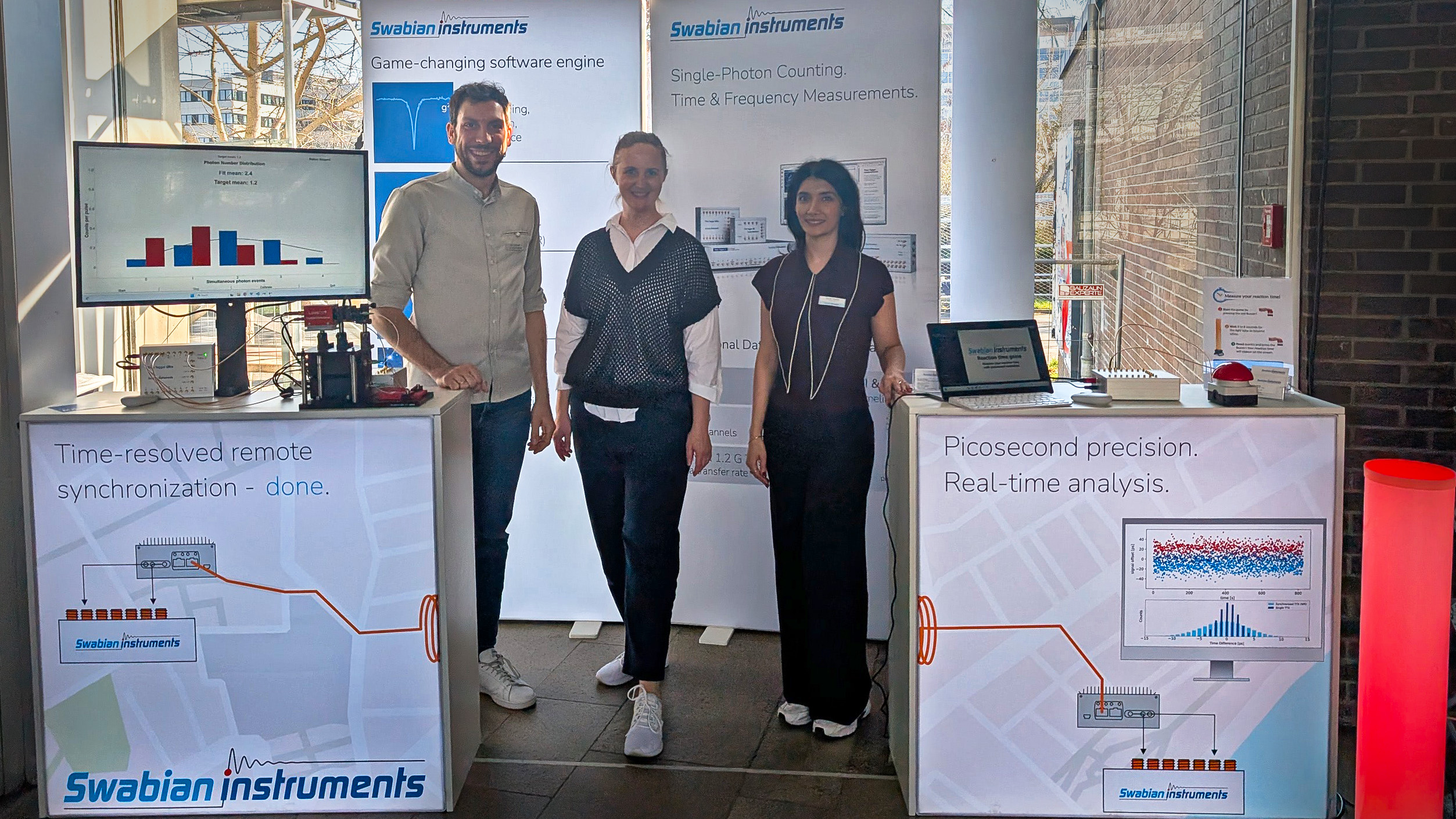
Beyond the scientific program, the conference also gave us the chance to demonstrate new features, showcase the capabilities of our instruments, and introduce an interactive demo that highlights the power of measurements with the Time Tagger.
Researchers Using Swabian Instruments Across the Community
DPG SAMOP is always full of inspiring talks and poster sessions, and SAMOP 2026 was no exception. Throughout the week, researchers shared new results across quantum optics, quantum technologies, and precision measurement.
One of the most rewarding aspects of the conference was seeing how widely Swabian Instruments’ devices are used across the research community. Scientists from many institutions presented work that relies on our instruments as part of their experimental setups.
Among the universities and research institutes represented were:
- University of Stuttgart
- TU Kaiserslautern
- University of Innsbruck
- TU Dresden
- FAU Erlangen-Nürnberg
- Universities in Berlin
- University of Mainz
- Saarland University
- University of Hamburg
- Fraunhofer Institutes
- Max Planck Institutes
and many more.
For our team, it is always meaningful to see how our instruments contribute to the progress of research. Conversations with these groups not only showed the diverse ways our devices are used, but also helped us better understand how we can continue supporting the community.
Introducing the Photon Number Distribution Demo
At DPG SAMOP 2026, visitors to the Swabian Instruments booth could explore a new interactive photon-number-distribution demo developed by our application scientist team, demonstrating the powerful capabilities of time-tagged photon counting.
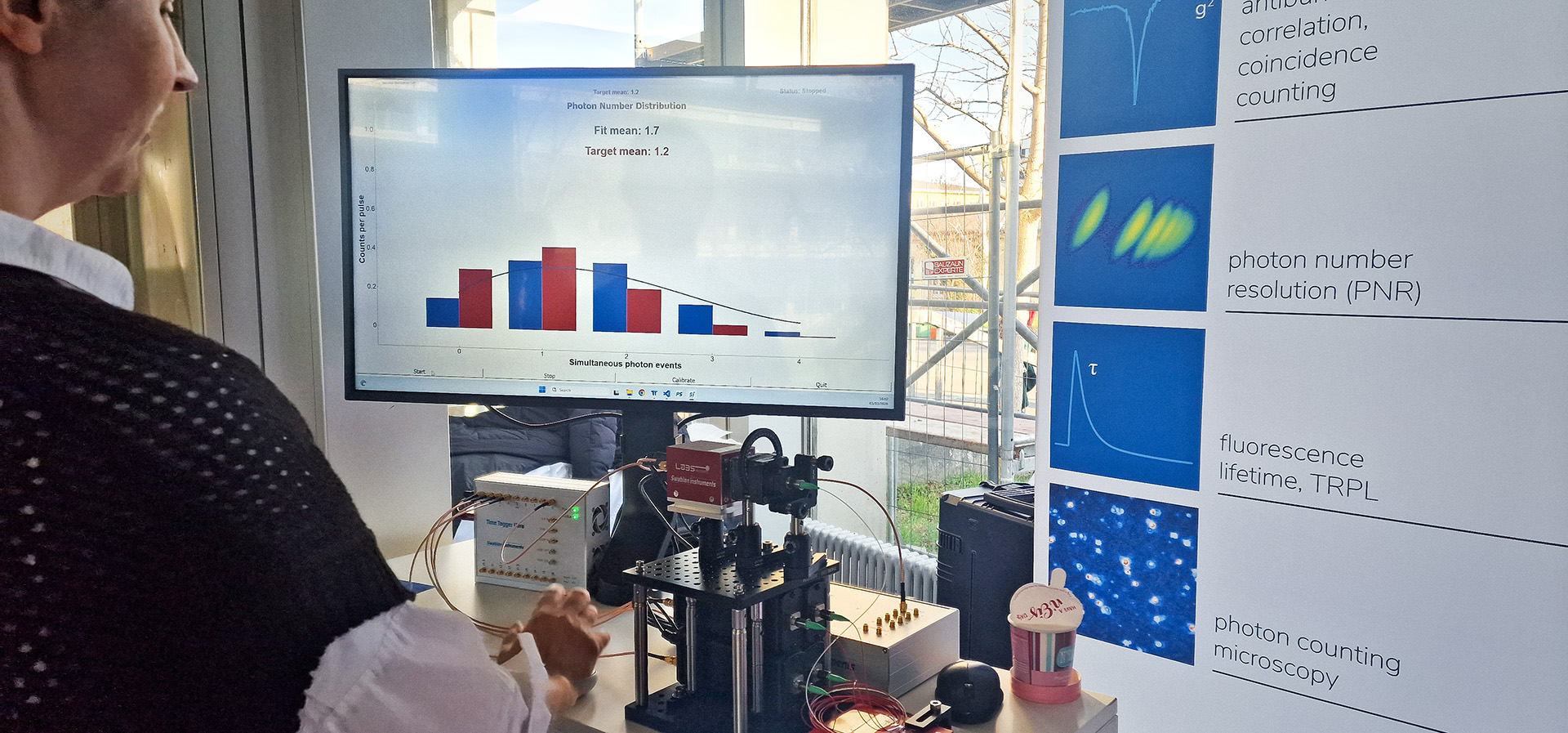
The challenge in this demo setup is to adjust an optical filter in front of a laser so that the measured distribution matches the target mean as closely as possible. As the filter is adjusted, the system updates in real time, allowing users to immediately see how their input changes the result.
The game’s setup follows a clear experimental flow. A pulsed laser, controlled by the Swabian Instruments’ Pulse Streamer, passes through an adjustable optical filter that controls the light’s intensity. The filtered photons are then sent to a beam splitter, which distributes them to four single-photon detectors. The signals from these detectors are recorded using the Time Tagger Ultra.
On the monitor, the measurement is visualized as a Poissonian photon number distribution. The x-axis shows how many detectors register photons at the same time, while the y-axis shows the counts per pulse. For example, a value of “3” means that three detectors detected photons simultaneously.
This is where the combination of channels using the virtual channel capability of the Time Tagger becomes essential. It enables the system to identify and count simultaneous photon-detection events across multiple channels with high timing precision, allowing the full photon-number distribution to be built in real time.
DPG SAMOP 2026 in Mainz was a great opportunity for the Swabian Instruments team to connect with researchers and see how our instruments are used in current experiments. It was especially rewarding to experience how our tools support work in quantum optics and photon counting across the community. We thank everyone who visited our booth, tried the demo, and shared their insights, and we look forward to continuing these conversations at future events.
Related Content
Photon Number Resolution (PNR)
Photon number resolution (PNR) is an enabling technique used to assign the number of photons involved in a detection event precisely.