American Physical Society (APS) Global Physics Summit 2026 + American Chemical Society (ACS) Spring 2026 Highlights
by Ginger (Tingting) Geng | on 24 April 2026
Swabian Instruments took part in APS Global Physics Summit 2026 in Denver and ACS Spring 2026 in Atlanta, where we engaged with researchers across physics, chemistry, materials science, and the life sciences. From picosecond-resolution photon counting with SNSPDs to FLIM, FRET, and dynamic light scattering, both meetings offered a valuable opportunity to share recent work, deepen technical discussions, and connect with the broader scientific community.
March was a busy month in the best way possible. As first-time attendees at the American Physical Society’s (APS) Global Physics Summit 2026 and the American Chemical Society (ACS) Spring 2026 Meeting, we moved from Denver to Atlanta, covering two major convening points in physics and chemistry, each offering a valuable perspective on the questions currently shaping their fields.
APS tends to lean more fundamental and physical, while ACS is often more chemical and applied. Yet both are driven by the same underlying challenge: how to extract meaningful answers from systems that resist easy interpretation. Taken together, they offered two distinct vantage points on a question at the heart of our work: how to measure light and time with sufficient precision to reveal relationships within systems that are noisy, dynamic, and inherently complex.
While APS leans more toward the fundamental and physical, and ACS more toward the chemical and applied, they’re both shaped by the challenge of extracting meaningful answers from systems that resist easy interpretation. Together, they offered two different entry points into a question that fuels the heart of our work: how to measure light and time precisely enough to reveal the relationships within systems that are often noisy, dynamic, and inherently complex.
American Physical Society Global Physics Summit 2026 in Denver, CO
This was the first year that APS held its newly unified format, which merged the APS March and April Meetings under the theme “Science for a Shared Future.” More than 14,000 physicists gathered in Denver across condensed matter, quantum information, photonics, nuclear physics, astrophysics, and physics education. The program was broad enough that the conference floor itself felt like a cross-section of where fundamental physics is right now.
It was also our first time exhibiting at APS, and we were glad to make it alongside our long time parters Single Quantum, whose SNSPD platforms lead in exceptional detection efficiency, low dark count rates, timing performance that operates cleanly in the picosecond regime, and a team that brings genuine technical depth to every conversation.
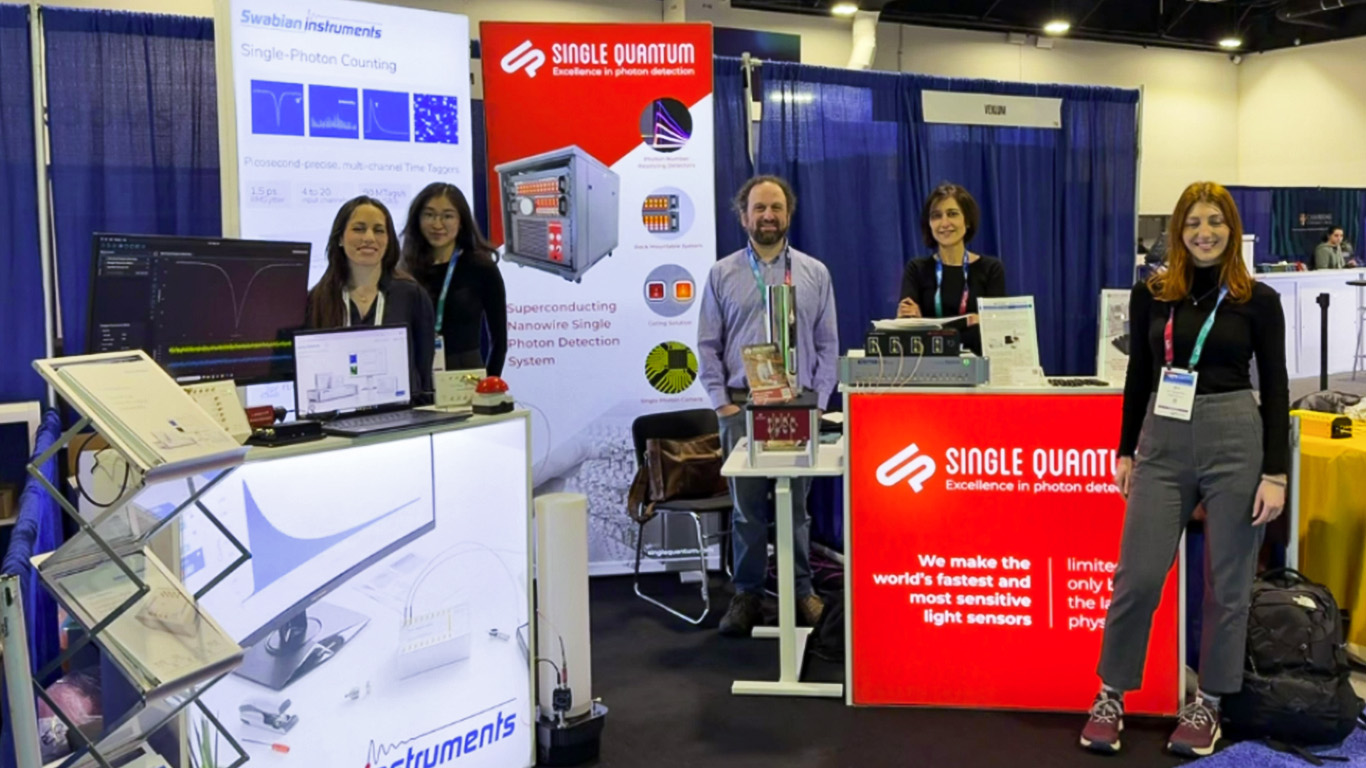
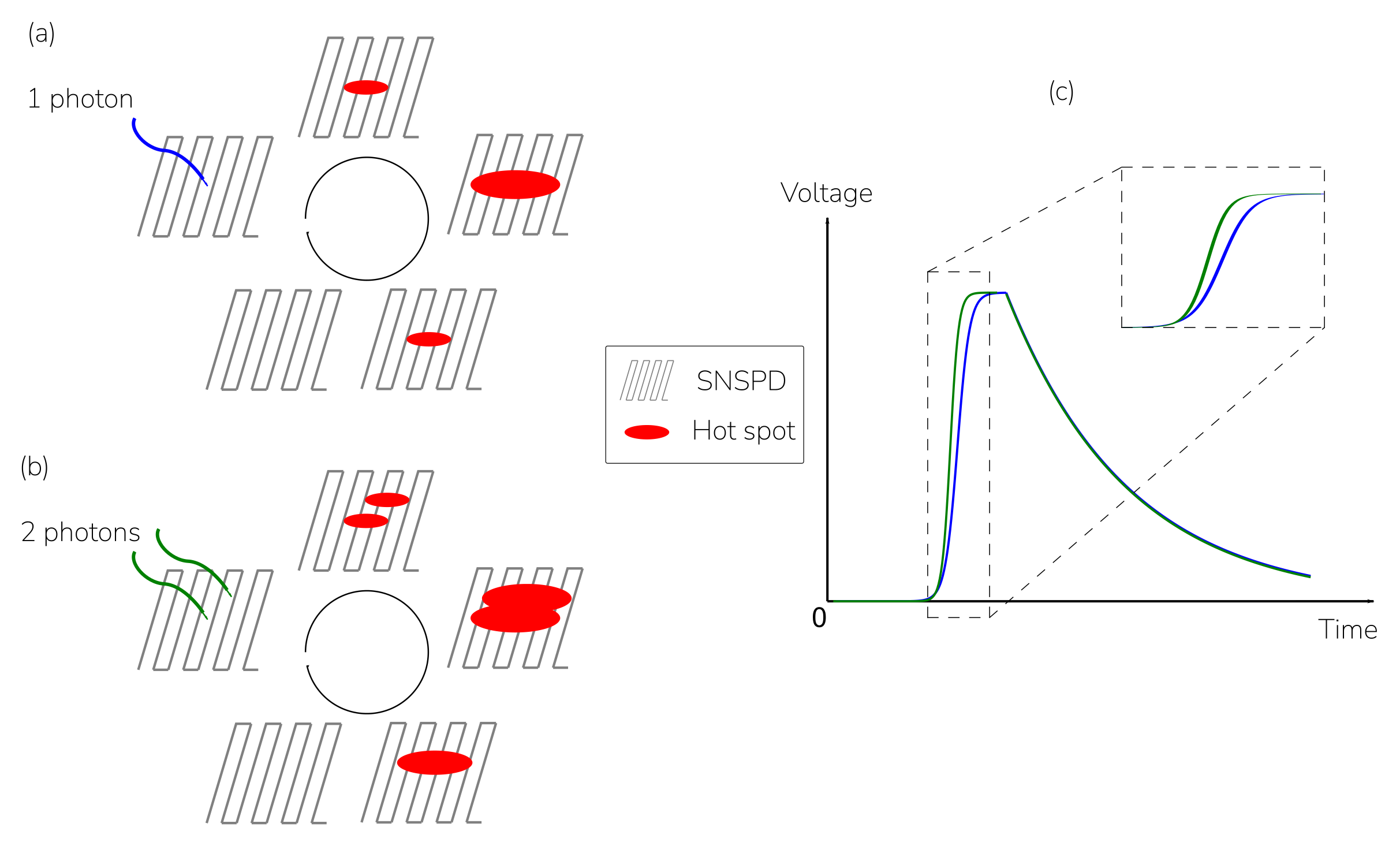
The collaboration extended beyond the booth itself. Swabian Instruments and Single Quantum gave a joint presentation on photon-number resolution (PNR) using superconducting nanowire detectors (SNSPDs) and high-resolution timing electronics, demonstrating what is possible when detection quality and timing precision are developed in close coordination. By timestamping the rising and falling edges of SNSPD output pulses, the system achieved a ~15.4 ps FWHM single-pixel response function. This is narrow enough to discriminate individual photons within a pulse from a single detector, without resorting to multi-pixel splitting approaches that introduce signal loss and architectural complexity. In quantum photonics, such performance supports cutting-edge, scalable, and deployable measurement architectures.
Tools in the Field with Industry Partners: Thorlabs and the Time Tagger 20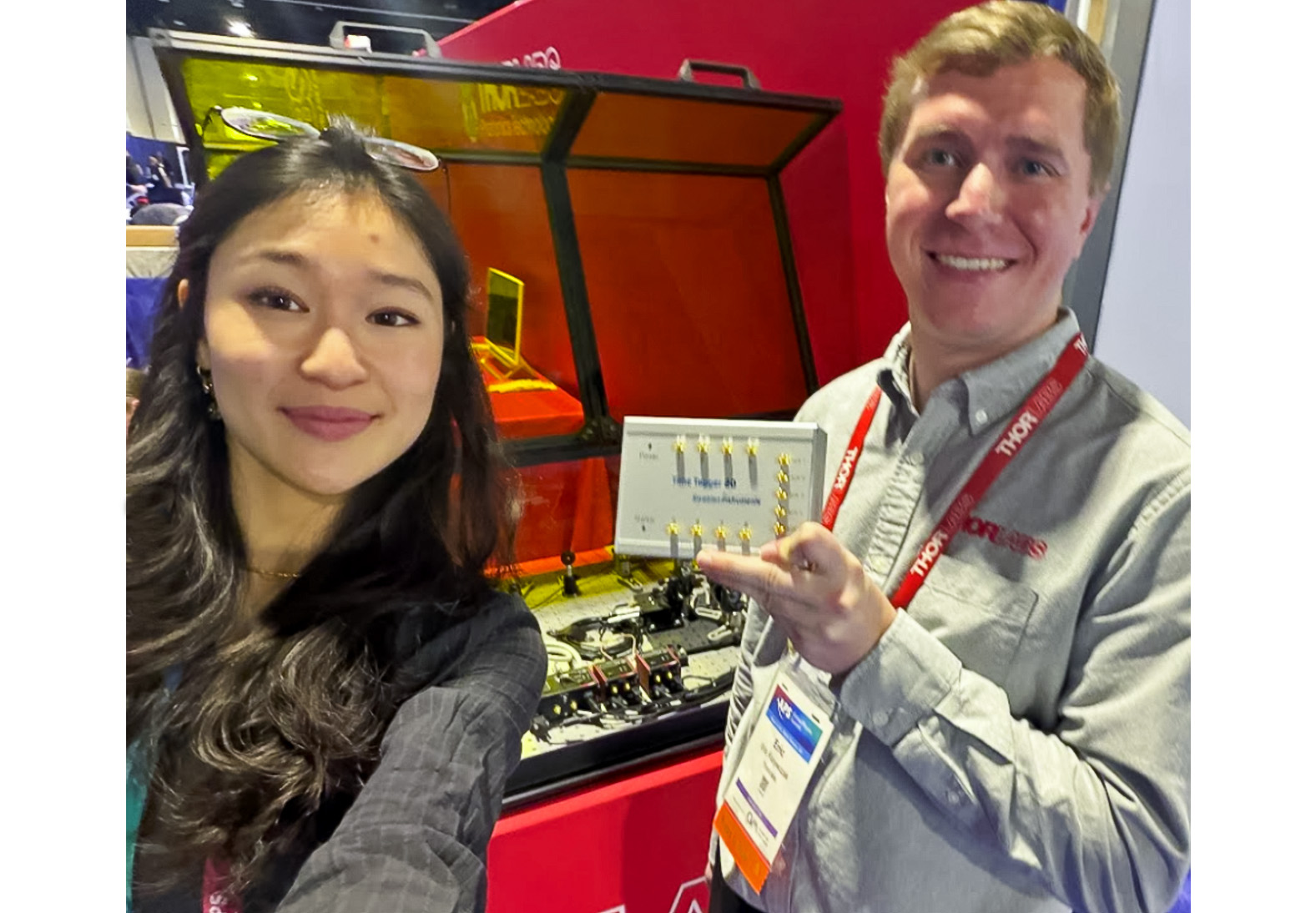
We also had the pleasure of catching up with Eric Kurywczak at Thorlabs. The Thorlabs Quantum Optics Educational Kit, which incorporates our Time Tagger 20, offers a streamlined, thoughtfully integrated platform for photon-counting experiments and, in the context of APS, has made it an especially popular system for research and teaching groups across AMO physics, quantum optics, and condensed matter.
The Broader APS 2026 Meeting
Beyond the technical content, what also stood out was the broader pattern - researchers pushing the limits of experimental methods within instrument capabilities and using those results to pioneer what comes next. We are honored to support that kind of work, and APS provided a shared space for it to be seen, discussed, and advanced.
We were also honored to hear from the 2025 Nobel Laureates in Physics, Dr. John M. Martinis, Dr. John Clarke, and Dr. Michel H. Devoret, whose contributions to superconducting qubit design and quantum coherence helped define the technical foundations on which much of quantum computing is now being built. Hearing from them gave a real perspective on the field’s scale of growth, and on how much of today’s landscape has emerged from a relatively compact set of architectural decisions and physical insights developed over the last few decades.
The inaugural Kavli Symposium covered topics ranging from neutrinos and astrophysics to the Hubble tension, and reminds us that fundamental physics is still producing open, high-stakes questions that don’t yield to incremental approaches. Squishy Science Sunday, which brought hands-on physics activities to families and the public, reflected a genuine commitment to the “shared future” at the heart of the meeting’s stated theme.
ACS Spring 2026 - Atlanta
From Denver, we headed straight to another first: attending the American Chemical Society Spring 2026 conference in Atlanta, under the theme “Collaborate, Innovate, and Transform.” This meeting carried a different flavor, but the same underlying current of researchers from across chemistry, materials, and life science coming together to exchange methods, troubleshoot experiments, and look for better ways to measure and refine the systems they rely on and define.
Measurement Across Disciplines: Fluorescence Lifetime Imaging (FLIM), Förster Resonance Energy Transfer (FRET), and Dynamic Light Scattering (DLS)
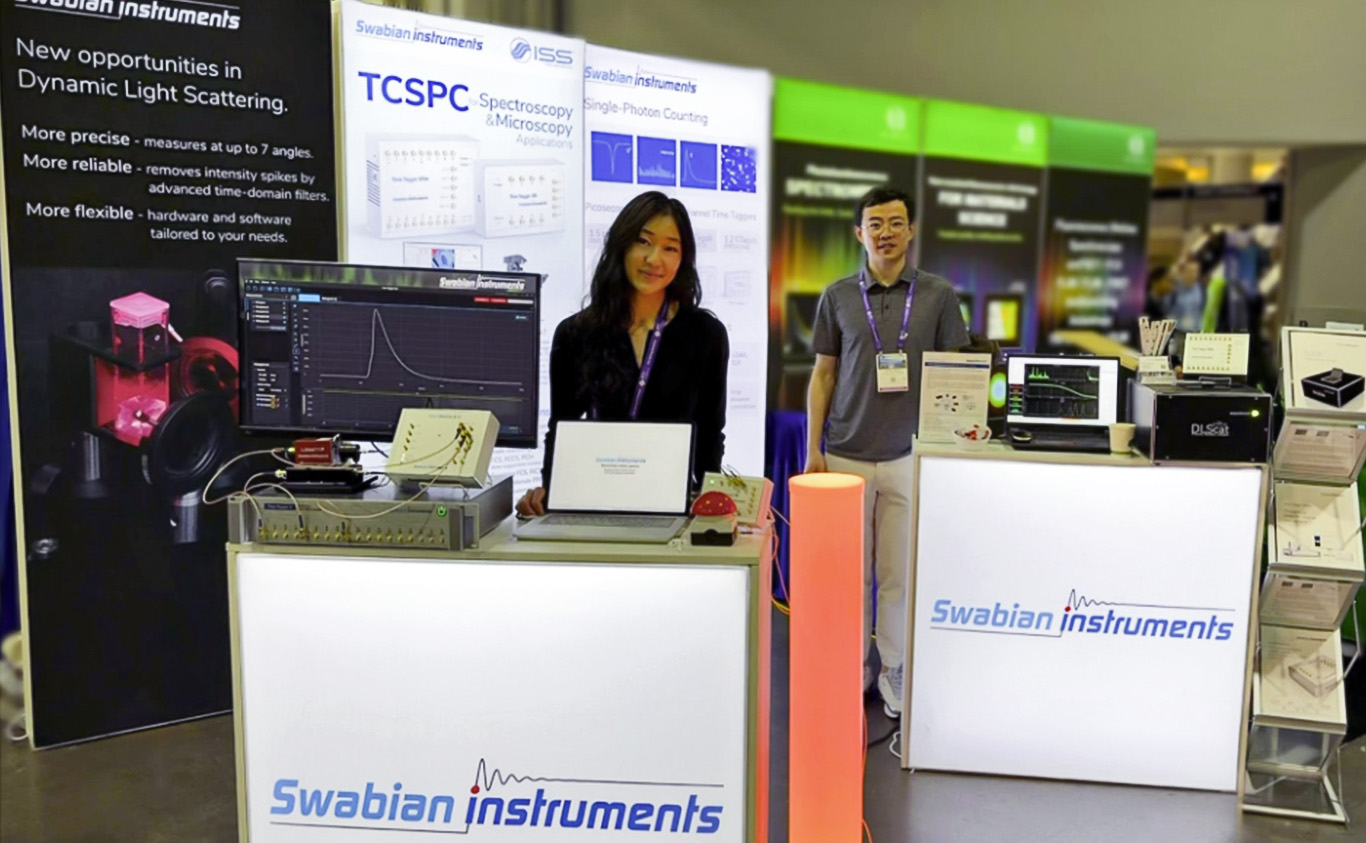
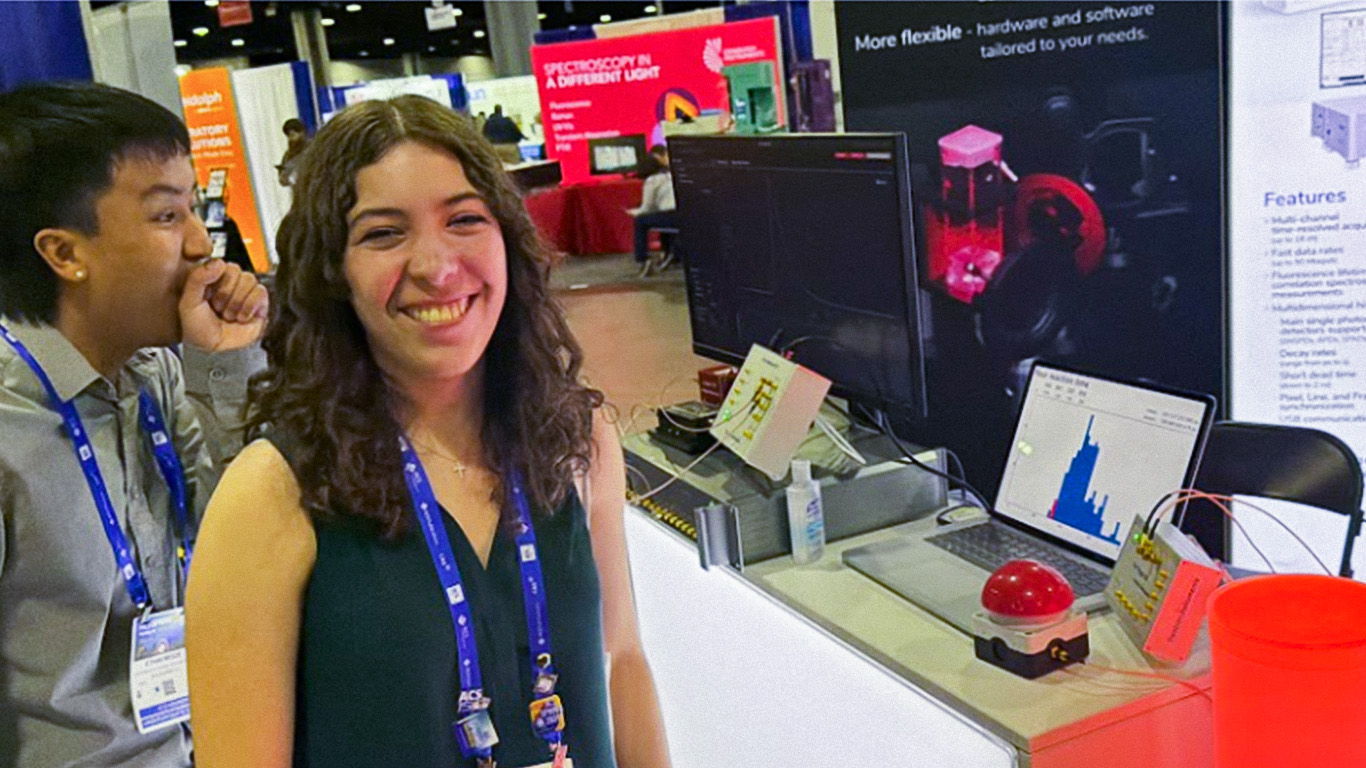
For us, ACS was a chance to highlight another side of what we do. At Booth #805, conversations extended beyond quantum photonics into Fluorescence Lifetime Imaging (FLIM), Förster Resonance Energy Transfer (FRET), and Dynamic Light Scattering (DLS), including interest in how photonics-based measurement tools can support researchers in chemistry, soft matter, and the life sciences. We enjoyed being able to demo and share our DLScat in action, showing how it can help extract reliable autocorrelation functions from scattered photon streams that require both temporal resolution and proper statistical handling to produce meaningful particle size or diffusion coefficient data.
The Broader ACS 2026 Meeting
ACS also tied this year’s meeting to its 150th anniversary celebration, and the program reflected the weight of that occasion. Dr. Omar Yaghi delivered the 150th-anniversary keynote, “Organic Chemistry and AI for Our Planet,” drawing on his long-term work in reticular chemistry and the potential of computationally guided material design for energy and climate applications. Dr. Jennifer Doudna appeared as the 2026 Priestley Medalist, ACS’s highest honor, in recognition of work that has become fundamental to both basic biology and applied medicine. Dr. Moungi Bawendi joined the Kavli Lecture Series, bringing a perspective shaped by decades of work on quantum-confined semiconductor nanocrystals with applications now spanning display technology, bioimaging, and quantum photonics. It was an honor to learn from such an impactful lineup of speakers.
Across both meetings, what stayed with us most was not only the science but the people. At conferences like APS and ACS, it’s exciting to be a part of where new ideas start to take shape in conversation, from posters, in booth demos, and quick technical questions, to chance introductions that turn into future collaborations. We were grateful to meet new customers, catch up with current users, and speak with researchers at every stage of their work, from early exploration to highly specialized measurement challenges.
At Swabian Instruments, we care deeply about building tools that genuinely help scientists move their work forward. Meetings like these are a reminder that continuing to push boundaries with instrumentation matters not for its own sake, but because it serves the bigger picture of helping make difficult experiments clearer, faster, and sometimes newly possible.
Thank you to everyone who stopped by, shared their work, asked thoughtful questions, or simply took the time to speak with us. We left both Denver and Atlanta encouraged by the scientific community, and are grateful to play a part in supporting the work ahead.
Related Content
Fluorescence Lifetime Imaging (FLIM)
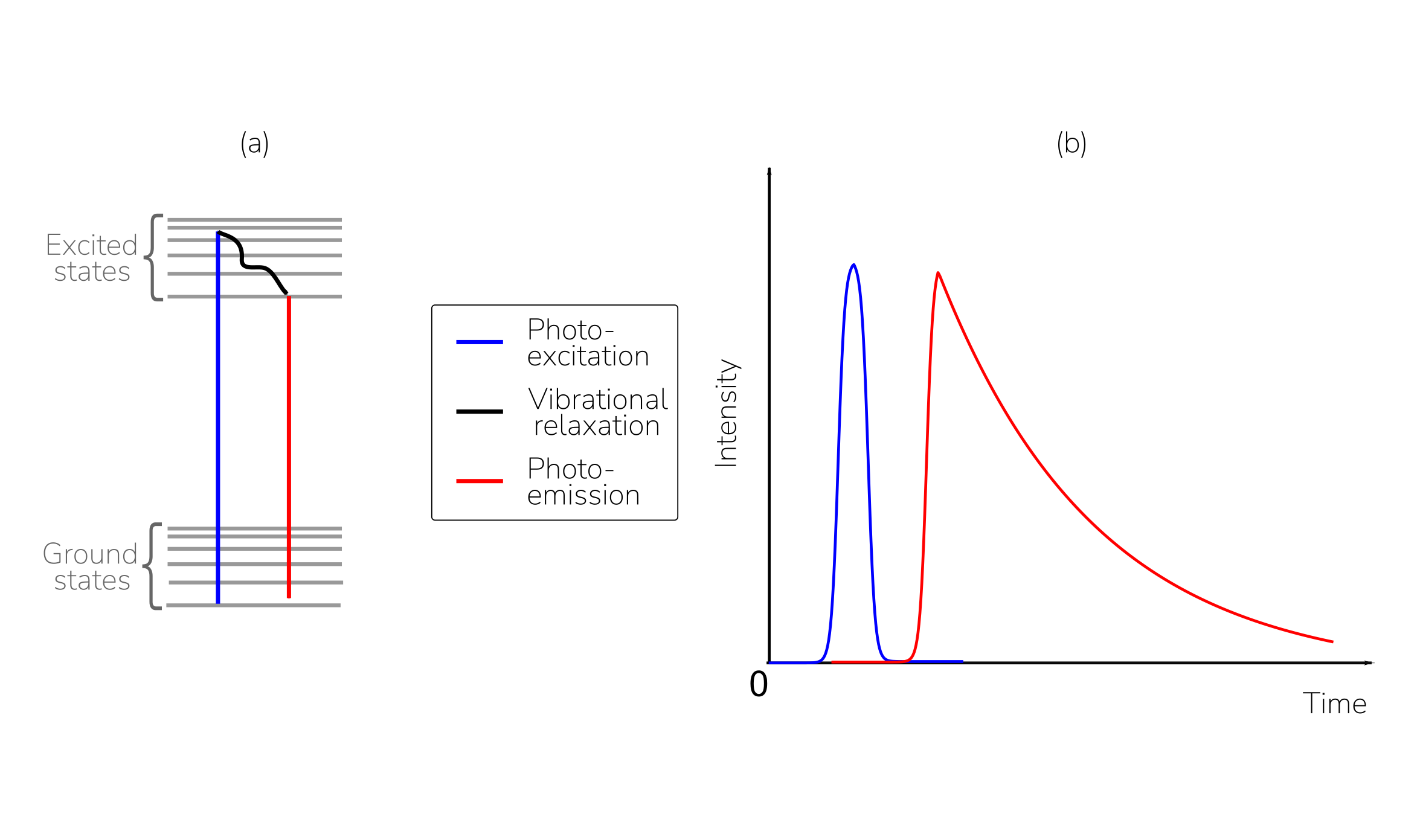
Discover fluorescence lifetime imaging (FLIM), a powerful imaging technique for mapping fluorescence lifetimes with picosecond precision. Learn how Swabian Instruments' Time Taggers enable high-resolution FLIM measurements using advanced timing electronics, supporting detectors like PMTs, SPADs, and SNSPDs for cutting-edge research applications
Dynamic Light Scattering (DLS) Particle Size Analysis
Next-generation multi-angle DLS turnkey design with built-in consistency checks, raw photon access, and intelligent spike filtering for fast, reliable particle sizing.

Photon Number Resolution (PNR)
Photon number resolution (PNR) is an enabling technique used to assign the number of photons involved in a detection event precisely.