
Quantum Optics and Photonics
What is Quantum Optics?
Quantum optics is the study of light at the level of individual photons and how these photons interact with matter. It explains effects that classical optics cannot, such as entanglement, photon antibunching, squeezed light and quantum interference. These effects are the foundation of quantum computing, quantum communication, quantum sensing and quantum networking.
Quantum optics applications we support
Intensity Interferometry
This page details the principles and advantages of intensity interferometry, a powerful technique in optical astronomy used to measure stellar diameters and spatial structure through photon correlation. Swabian Instruments’ Time Taggers enable high-precision, scalable, and synchronized intensity interferometry experiments with picosecond timing resolution, real-time data processing, and long-baseline support.

Photon Number Resolution (PNR)
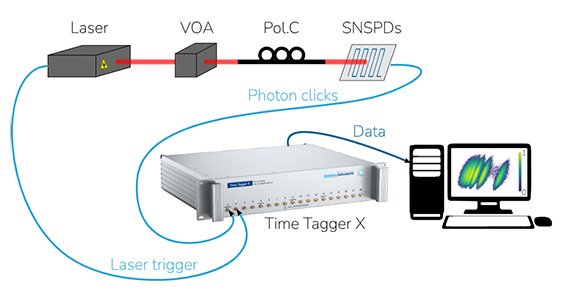
Photon number resolution (PNR) is an enabling technique used to assign the number of photons involved in a detection event precisely.
Linear Optics Quantum Information (LOQI)
Explore Linear Optics Quantum Information (LOQI) and its applications in quantum computing and secure communication. Learn about Swabian Instruments' Time Taggers and their role in precise photon detection, timing, and analysis for advanced quantum experiments.

Photonic Integrated Circuits (PIC)
Learn how Swabian Instruments’ Time Tagger supports advanced testing workflows in photonic integrated circuits (PICs) and quantum photonics by enabling precise characterization of optical components and quantum devices. Researchers can reliably capture correlations, coincidences, wafer testing, and timing dynamics across complex detector arrays, thereby accelerating the development and validation of next-generation photonic systems.

Why is Time Tagging important for Quantum Optics?
Most quantum optics experiments depend on knowing exactly when each photon arrives, not only how much light there is. Swabian Instruments Time Taggers record photon arrival times with picosecond resolution, high throughput and very low timing jitter, using time-correlated single photon counting (TCSPC). This makes it possible to measure photon correlations, coincidence events and temporal dynamics from extremely weak signals, which is what entanglement verification, HBT and HOM measurements require. Where an experiment also needs precise control and synchronization of lasers, detectors or gates, the Pulse Streamer Series provides an easy-to-use solution.