
Time-Resolved Materials Characterization
What is time-resolved materials characterization?
Time-resolved materials characterization measures how a material responds in the first picoseconds to microseconds after optical or electrical excitation. Many material properties, such as carrier lifetimes, emission dynamics and phase transitions, only show up on these short timescales. Resolving them is essential for developing materials for electronics, photonics, quantum sensing, aerospace and renewable energy.
Materials science applications we support
SLR and LiDAR: Solutions for High-Precision Remote Sensing
Next-generation multi-angle DLS turnkey design with built-in consistency checks, raw photon access, and intelligent spike filtering for fast, reliable particle sizing.

Optically Detected Magnetic Resonance (ODMR)
Optically detected magnetic resonance (ODMR) is a powerful technique widely used in quantum sensing, magnetic field measurement, and material analysis.

Brillouin Light Scattering (BLS)
Brillouin Light Scattering (BLS) is a powerful optical spectroscopy technique used to probe phonons, magnons, and viscoelastic properties of materials across solid-state, biological, and sensing applications. Swabian Instruments Time Taggers play a critical role in modern BLS experiments by enabling picosecond-resolution photon time-stamping, reliable synchronization with interferometric setups, and real-time reconstruction of frequency-resolved spectra. By combining Time Taggers with Fabry–Pérot interferometry and single-photon detection, researchers achieve accurate, scalable, and time-resolved BLS measurements for materials science, spintronics, biomedical research, and remote sensing.

Electron Paramagnetic Resonance (EPR) / Electron Spin Resonance (ESR)
Electron paramagnetic resonance (EPR) is a powerful spectroscopy technique used to study materials with unpaired electrons through continuous-wave or pulsed microwave measurements. Advanced pulsed EPR experiments require precise synchronization, nanosecond pulse control, and low timing jitter. The Swabian Instruments Pulse Streamer 8/2 provides the high-speed, multi-channel timing control needed to reliably orchestrate complex pulsed EPR experiments.

Quantum Dot Single-Photon Sources
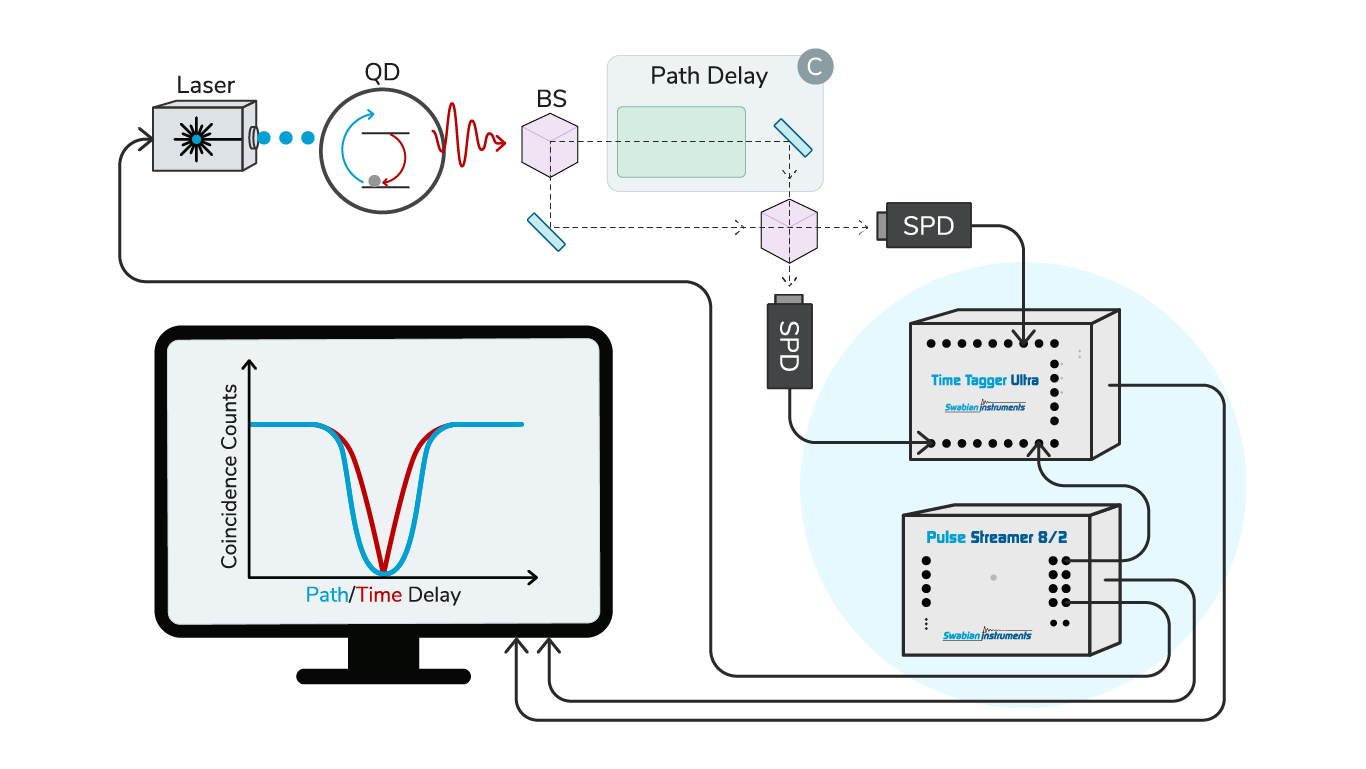
Swabian Instruments’ Time Tagger and Pulse Streamer provide picosecond-level timing resolution, fast digital pulse generation, and high data-throughput capabilities used in the characterization of quantum-dot single-photon sources.
Why is Time Tagging important for Materials Science?
Time-correlated single photon counting (TCSPC) lets researchers observe transient optical phenomena with picosecond precision. Swabian Instruments Time Taggers record the arrival time of every detected photon and stream the raw data, so lifetime histograms and time-resolved spectra can be built live and re-analyzed later. For experiments that need synchronized excitation pulses, gates and detectors, the Pulse Streamer Series provides the timing signals.