Brillouin Light Scattering (BLS)
Introduction to Brillouin Light Scattering (BLS)
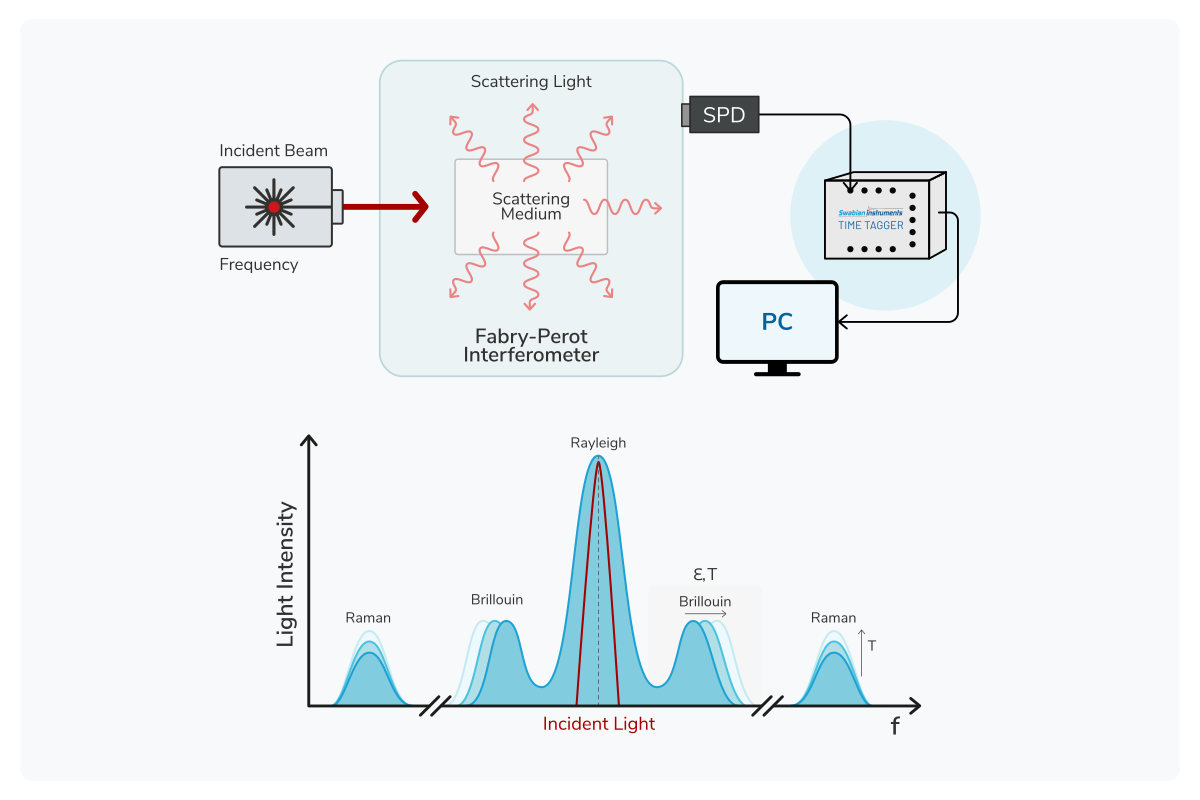
Brillouin light scattering (BLS) is an optical technique used to evaluate a material’s mechanical properties, spin-dependent transfer phenomena, and spin wave propagation. Brillouin Light Scattering leverages the principle of inelastic scattering of light, resulting from the interaction of light with material waves in a medium. In solid-state physics, BLS involves the interaction between an electromagnetic wave and a type of crystalline lattice wave, or “quasiparticles”, such as phonons, responsible for acoustic interactions; magnons, responsible for spin-wave interactions; or polarons, responsible for electron–lattice coupling.
The BLS process can result in an increase in photon energy if the quasiparticle is absorbed or a decrease if the quasiparticle is created. By measuring the energy, wavelength, and frequency of the quasiparticles during BLS, one can obtain information about the dynamic properties of materials in the frequency domain 1.
Brillouin Light Scattering can be used for a variety of applications, including:
Spintronics Research & Spin Wave Dynamics
- To investigate spin-dependent transport phenomena, spin current behavior, and spin wave propagation (including magnon-phonon interactions, linear and nonlinear dynamics, and magnet Bose-Einstein condensation phenomena) 2.
Materials Research
- To characterize the stiffness and viscosity properties of materials under evaluation 3, e.g., for real-time, non-contact analysis of the viscoelastic properties of agar media 4.
Medical Applications
- To evaluate viscoelastic properties of heterogeneous tissues and systems, such as the eye (corneal aging, hydration, and degeneration all affect Brillouin frequency) 5.
Long-Range Sensing and Monitoring via Spaceborne Brillouin Scattering LiDAR
- For wide-range and long-term monitoring of upper-ocean water bodies 6, including the detection of submerged objects and the measurement of water bulk viscosity 7.
Two other optical scattering phenomena that are sometimes mistaken for Brillouin Light Scattering are Rayleigh Scattering and Raman Scattering. Rayleigh Scattering is elastic and only involves random, incoherent fluctuations, in contrast to Brillouin scattering, where fluctuations are periodic and correlated. Raman scattering is an inelastic process in which photons are scattered due to vibrational and rotational transitions in the bonds between first-order, neighboring atoms, whereas BLS results from the scattering of photons due to large-scale, low-frequency phonons. The following table compares the differences between BLS, Rayleigh, and Raman Scattering 8 5:
| Rayleigh Scattering | Raman Scattering | Brillouin Light Scattering | |
|---|---|---|---|
| Interaction | Light and small particles or inhomogeneities (elastic scattering, no energy shift) → strong intensity | Light with phonons or vibrations (inelastic scattering, THz range) → weak intensity | Light and quasiparticles (inelastic scattering of GHz range) → very weak intensity |
| Measurements & Applications | Particle size and shape analysis, refractive index fluctuations, atmospheric optics (e.g., LiDAR) | Study of optical photons, label-free chemical mapping of biomaterials, molecular composition, chemical bonds, structure, vibrational modes (via Raman spectrometer or interferometers) | Study of acoustic phonons, viscoelastic properties (via Fabry–Pérot interferometer or heterodyne detection) |
The Role of Timing Electronics in Brillouin Light Scattering (BLS)
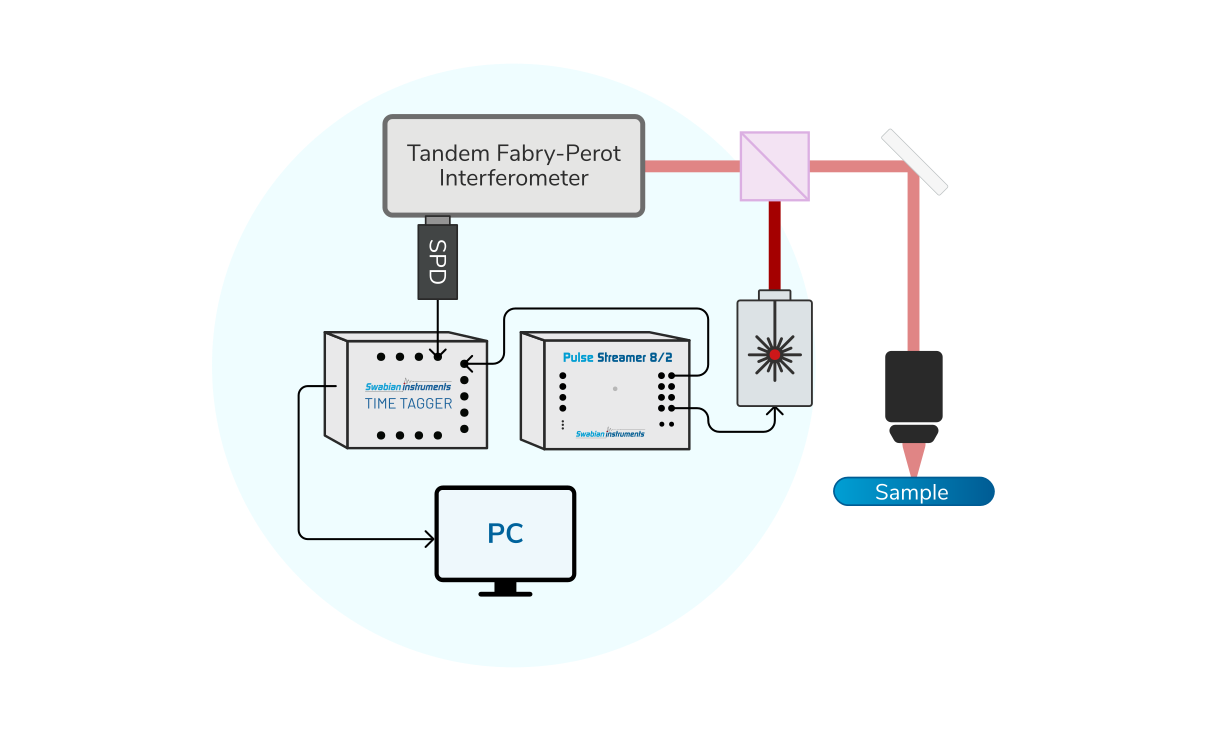
In a typical Brillouin Light Scattering experiment, a monochromatic continuous-wave laser, commonly operating at 532 nm, is focused onto the surface of a sample to probe light–matter interactions. The scattered light may be elastic (Rayleigh scattering) or inelastic (Brillouin scattering), the latter providing information about excitations within the material. The backscattered light is directed via a beam splitter into a Tandem Fabry–Pérot Interferometer (TFPI), which serves as an optical filter to analyze the frequency shifts resulting from photon–magnon or photon–phonon interactions.
A time-to-digital converter acquires data from the pattern generator used for synchronization, the photon detector inside the TFPI, and the control signals that encode the current state of the interferometer. Then, the temporal evolution of the spectra is reconstructed. By analyzing the frequency shift of the scattered light, scientists can characterize phonons and magnons present in the material. 2 9
Common Challenges in Brillouin Light Scattering (BLS) Application with Conventional Timing Electronics
In Brillouin Light Scattering setups, conventional timing electronics may result in challenges due to:
- Inefficient synchronization and experimental control: Electronics that are difficult to program and lack flexibility can result in challenging tasks when attempting to synchronize excitation pulses with detection, as well as in situations involving multiple sources.
- Limited inputs: Timing electronics with an insufficient number of channels or with dedicated inputs for “start” or “stop” signals limit the ability to record multiple signals simultaneously. The limitations result in less overall experimental flexibility and difficulties in scaling the setup.
- Low timing resolution: Insufficient to capture ultrafast spin-wave or phonon dynamics in real time.
- Slow data throughput: Insufficient speeds can be particularly challenging, especially when dealing with high data rates.
Swabian Instruments’ competitive solution for Brillouin Light Scattering (BLS)
Swabian Instruments’ instrumentation is well-positioned to facilitate BLS experiments:
Flexible Run Length Encoding sequence programming across multiple outputs of the Pulse Streamer facilitates the signal generation for experiment control and synchronization capabilities.
Multiple fully equivalent, independent channels on the signal acquisition side are achieved through the multichannel capabilities of the Time Taggers, providing flexibility to seamlessly acquire data from multiple channels and perform experiments simultaneously in real-time.
Picosecond timing resolution enables accurate time-resolved BLS and ultrafast dynamics studies. The low jitter associated with the Pulse Streamer signal generation results in efficient control of the components in the setup, whilst the low jitter of the Time Tagger (down to 1.5 ps RMS) accomplishes precise acquisition of the photon detections.
High sustained data rates: Real-time data acquisition and analysis can be performed with an application programming interface (API) in the most common programming languages, including MATLAB, Python, LabVIEW, and C++. Data transfer is handled via USB 2.0 with the Time Tagger 20 and USB 3.0 with the Time Tagger Ultra and Time Tagger X, ensuring fast and reliable communication. An additional interface is available in the Time Tagger X for fast-feedback, low-latency applications (more info in our Github repository).
Application Examples of Brillouin Light Scattering (BLS)
The Time Taggers and Pulse Streamer 8/2 have been successfully integrated in Brillouin Light Scattering experiments, as demonstrated in the following literature:
Pulse Streamer 8/2 to create the “start” signal and serve for synchronization purposes. For example:
- To synchronize two separate RF sources in the BLS setup, gated through an arbitrary shape9.
- To investigate magnon–magnon scattering processes in patterned magnetic films. The precise synchronization between magnon excitation pulses and photon detection was critical for capturing the ultrafast dynamics of magnon redistribution in momentum space 10.
Time Taggers for timestamping of single-photon detections and frequency signals. For example:
- Time Tagger 20: used to reconstruct the temporal evolution of spin-wave intensity and frequency with sub-nanosecond precision 10.
Both Time Tagger and Pulse Streamer:
- A variety of BLS microscopy setups include both a Time Tagger for high-resolution time-resolved measurements and a Pulse Streamer for signal generation 11.
Full-stack solution for time-resolved measurements:
- Swabian Instruments collaborates with THATEC for a turn-key setup that offers automatic alignment and stabilization, flexible multi-region frequency scans, long-duration automated measurements with synchronized device control, and reconstruction of time-resolved spin-wave spectra over nanosecond timescales. More info in the application note: Time-resolved BLS / Time Tagger – THATec Innovation 12.
To summarize, Brillouin Light Scattering is a versatile spectroscopic technique to measure material properties (including the analysis of magnetic properties and the measurement of stiffness of biological tissues) as well as for long-range sensing and monitoring applications. The use of precise electronics in signal generation and timestamping ensures a successful and efficient implementation of Brillouin Light Scattering experiments.
Application Note
Time-Resolved Brillouin Light Scattering (BLS)
Brillouin_Scattering_Swabian_Instruments.pdfBlachowicz, T. (2024). Scattering: Inelastic scattering technique- Brillouin. Science Direct, Volume 4, Pages 187-193. https://doi.org/10.1016/B978-0-323-90800-9.00067-6. ↩︎
Dunagin, R., Serga, A., & Bozhko, D. (2025). Brillouin light scattering spectroscopy of magnon–phonon thermal spectra of an in-plane magnetized YIG film in two-dimensional wavevector space. J. Appl. Phys. 137, 083901. https://doi.org/10.1063/5.0251149. ↩︎ ↩︎
Cheburkanov, V., et al (2025). Brillouin Spectroscopy: A Non-Invasive Method for Assessing the Viscoelastic Properties of Biologically Relevant Polymers. JBMR. 113, 7. https://doi.org/10.1002/jbm.a.37965. ↩︎
Esteves, B., et al (2023). Non-contact determination of the viscoelastic properties of agar culture media by Brillouin spectroscopy. Materialia, 30, 101858. https://doi.org/10.1016/j.mtla.2023.101858. ↩︎
Palombo, F., Fioretto, D. (2019). Brillouin Light Scattering: Applications in Biomedical Sciences. Chemical Reviews. Vol 119, Issue 13. https://doi.org/10.1021/acs.chemrev.9b00019 ↩︎ ↩︎
Yuan, D., et al. (2021). Potential of spaceborne Brillouin scattering lidar for global ocean optical profiling. Optics Express. Vol. 29, Issue 26, pp. 43049-43067. https://doi.org/10.1364/OE.442376 ↩︎
Liu, Dh., Shi, Jw., Chen, Xd. et al. Brillouin lidar and related basic physics. (2010). Front. Phys. China 5, 82–106 . https://doi.org/10.1007/s11467-009-0071-1 ↩︎
Rayleigh vs Raman Scattering. (Online, Accessed November 3rd, 2025) ↩︎
Körber, L., Heins, C., Hula, T. et al. (2023) Pattern recognition in reciprocal space with a magnon-scattering reservoir. Nat Commun 14, 3954. https://doi.org/10.1038/s41467-023-39452-y ↩︎ ↩︎
Heins, C., Kim, J., Körber, L., et al. (2025). Benchmarking a magnon-scattering reservoir with modal and temporal multiplexing. Phys. Rev. Applied 23, 054087. https://doi.org/10.1103/PhysRevApplied.23.054087 ↩︎ ↩︎
Magnetometrie - Helmholtz Zentrum Oresden Russendorf. (Online, Accessed November 3rd, 2025) ↩︎
Time-resolved BLS / Time Tagger – THATec Innovation. (Online, Accessed November 3rd, 2025) ↩︎