
Advances in Single Photon Light Detection and Ranging (SP-LiDAR) at Mitsubishi Electric Research Laboratories
by Maré Sutphen | on 11 June 2026
Scientists at Mitsubishi Electric Research Laboratories (MERL) in Cambridge, Massachusetts, are using Swabian Instruments Time Taggers to develop Doppler Single Photon LiDAR methods that measure an object’s distance and velocity.
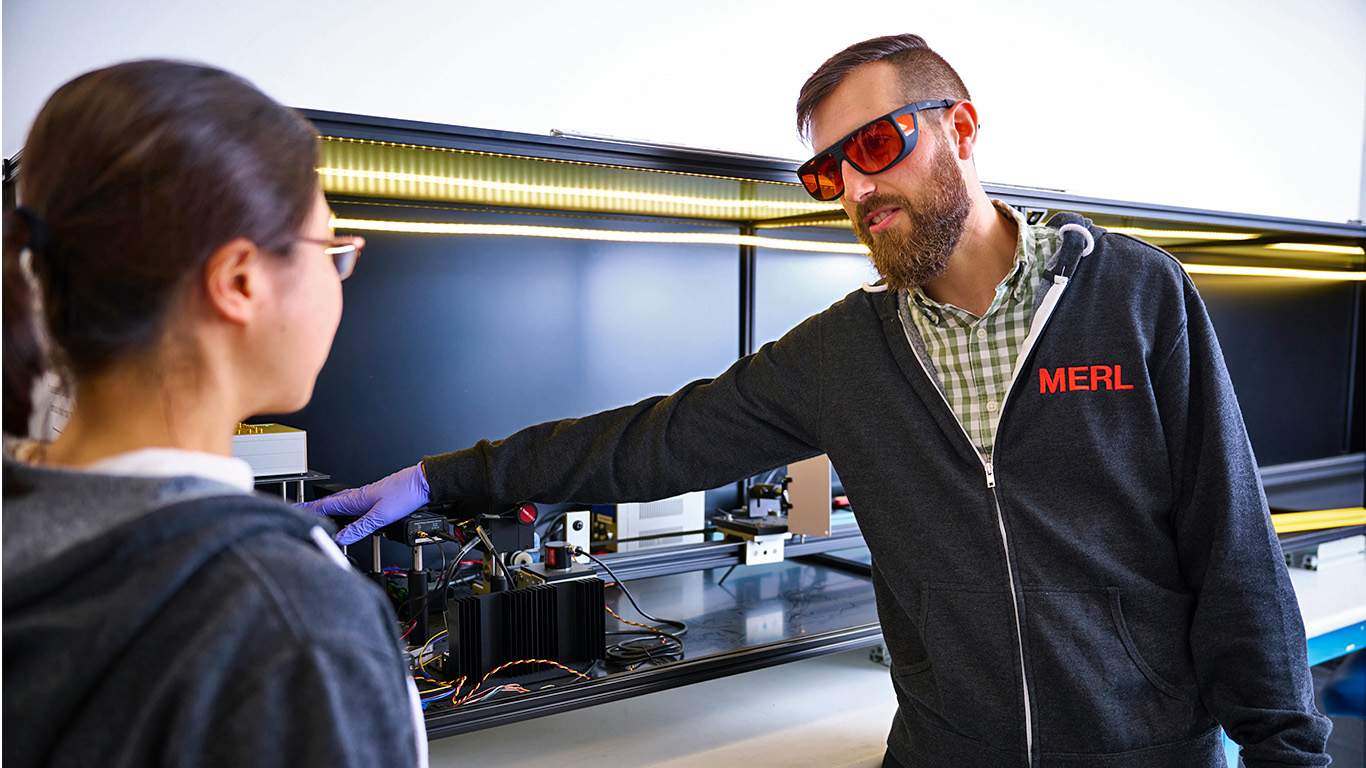
Single Photon LiDAR at Mitsubishi Electric Research Labs (MERL)
Joshua Rapp is a Principal Research Scientist on the Computational Sensing Team at MERL. His research focus is 3D estimation using optical sensors such as Light Detection and Ranging (LiDAR), a remote-sensing technique that measures distances by calculating the time it takes for a laser pulse to travel to an object and back. By scanning the laser over a large area, LiDAR measurements can be built up into accurate 3D maps of terrain, structures, and environments. Single photon LiDAR (SP-LiDAR) is an advanced technique that uses single photon detectors to measure significantly weaker return signals, enabling long-range mapping and high-resolution data collection.
Measuring Velocity from Photon Timestamps
Traditional SP-LiDAR measurements keep track of the time between a laser pulse and a photon detection, which is converted to a distance using the speed of light. However, that measurement model assumes an object is static, so repeated pulses are expected to return from the same distance.
Joshua’s team realized that keeping track of the full sequence of photon timestamps—not just the time since a laser pulse—could yield information about an environment evolving over time. Together with intern Ruangrawee Kitichotkul and MERL colleagues Yanting Ma and Hassan Mansour, Joshua built a new LiDAR system to capture not only distances to objects but also their radial velocity. The LiDAR uses a sequence of pulses to illuminate a target; if the target is moving, the reflected pulse sequence is compressed or expanded in time due to the motion. Velocity measurement is achieved by using the full sequence of photon timestamps to estimate this Doppler shift in the repetition frequency of the received laser pulse stream.
Extracting velocity from subtle timing shifts elevates the time tagger to a critical system component. A publication in Optica describes Rapp’s SP-LiDAR system 1, consisting of a synchronized pulsed 450 nm laser, a silicon single-photon avalanche diode (SPAD) detector, and Swabian Instruments’ Time Tagger Ultra in Performance mode (TTUltra). They used the TTUltra to stamp the laser pulses and the detection events while illuminating targets mounted on belt-driven motion stages and rotating fan blades. To evaluate the LiDAR’s performance, they then estimated the velocity and range across different target speeds, laser powers, and background light levels.
When asked how the TTUltra impacted his work, Joshua answered, “The most challenging part of our experimental work was timing: we needed to synchronize our lidar measurements with established reference systems to demonstrate the accuracy of our method. Moreover, we discovered that velocity accuracy required the laser repetition period to be estimated to within about 10 femtoseconds. The TTUltra gave us the stability, precision, and flexibility to do all that.” When asked what specs of the device contributed to his work the most, he noted that the device’s low jitter (8 ps RMS for the TTUltra) and many independent input channels (up to 18 in a single system) were critical for his research. He also noted, “It has low deadtimes, which is extremely helpful when dealing with photon counting statistics.”
Joshua’s team is excited to continue this research, noting they have had great progress. His team recently published a follow-up paper in Optics Express 2 showing that the Doppler SP-LiDAR technique could be extended to non-periodic pulse sequences, which enables distance and velocity measurement over a much longer unambiguous range. “It’s amazing how much information you can encode into and extract from these timestamps. You just need to have equipment that can record timestamps for each individual photon detection.”
Swabian Instruments is excited to continue to support MERL’s research efforts as they further develop methods for single-photon LiDAR.
Related Topics
SLR and LiDAR: Solutions for High-Precision Remote Sensing
Next-generation multi-angle DLS turnkey design with built-in consistency checks, raw photon access, and intelligent spike filtering for fast, reliable particle sizing.


Time of Flight Light Detection and Ranging (ToF LiDAR)
References
R. Kitichotkul, J. Rapp, Y. Ma, and H. Mansour, “Simultaneous range and velocity measurement with Doppler single-photon lidar,” Optica, vol. 12, no. 5, pp. 604–613, May 2025. ↩︎
R. Kitichotkul, J. Rapp, Y. Ma, and H. Mansour, “Unambiguous range extension for Doppler single-photon lidar,” Opt. Express, vol. 34, no. 9, pp. 15933–15952, May 2026. ↩︎