作者 | 日期 19 February 2026
The Swabian Instruments team returned to San Francisco this January for the 2026 Photonics West conference. We had the pleasure of demonstrating our devices at the exhibition. connecting with experts in the materials science and photonics & optics fields, and met with users to discuss their experiences and feedback. Our team enjoyed the chance to talk with existing users about their experiences with our devices and collect feedback. We addressed our users’ questions and connected them with our support team for further assistance.
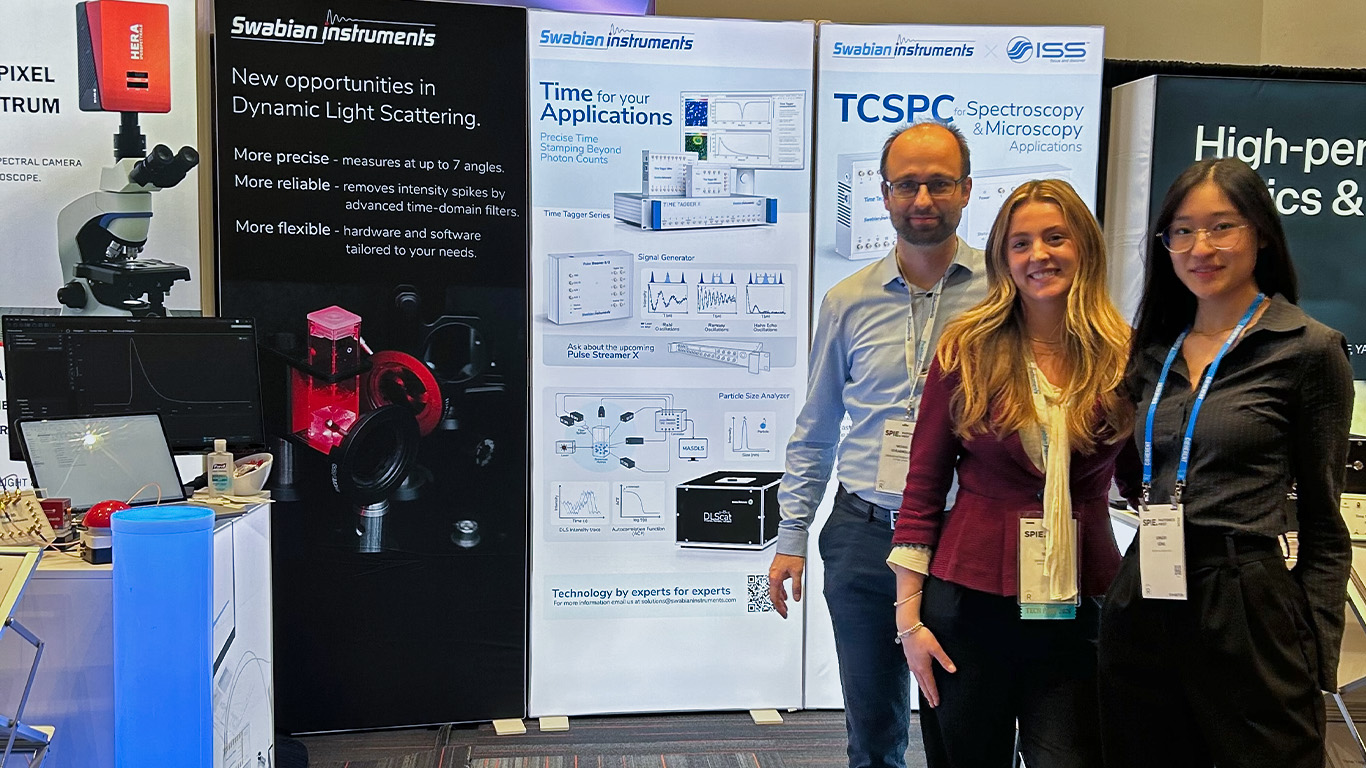
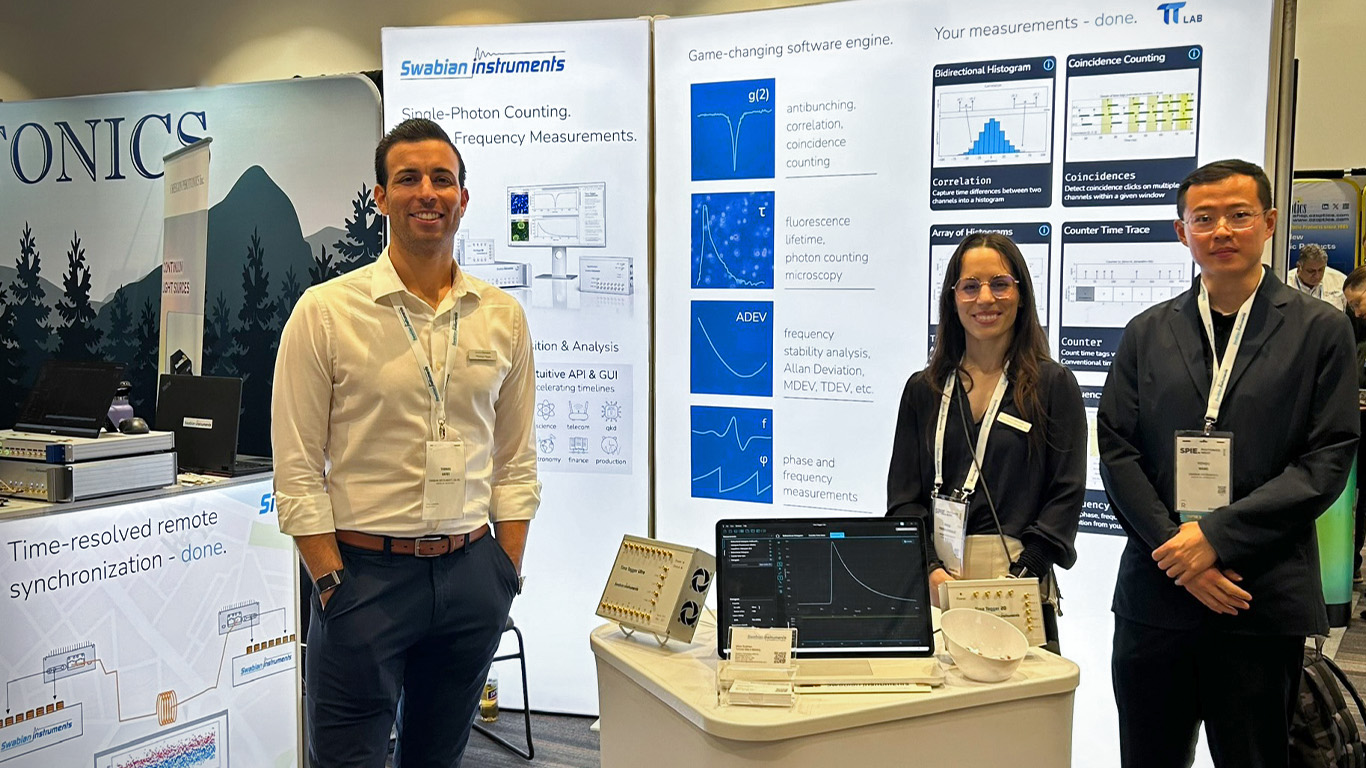
This year, we had two booth locations at the BiOS show, which takes place on the first 2 days of the conference. Our first booth showcased our turnkey Dynamic Light Scattering (DLS) solution, DLScat. Many conversations focused on the value of multi-angle DLS for kinetic experiments, particularly for tracking aggregation, binding, or structural evolution in real time. DLScat approaches particle size analysis differently by leveraging the capabilities of the Time Tagger 20 to enable simultaneous multi-angle DLS (MASDLS) with up to five angles and real-time analysis. This provides higher information density per measurement and allows users to access raw photon streams for post-processing, such as re-binning in time, re-computing correlations, or applying advanced filtering without re-acquiring data.
In some conversations, we also learned that there is an interest in DLS and fluorescence correlation spectroscopy (FCS) within a single measurement platform, reflecting growing interest in hybrid approaches for studying dynamics across different contrast mechanisms. These exchanges highlighted how DLScat is particularly well suited for kinetic studies of evolving systems, as well as polydisperse, temperature-dependent, or otherwise challenging samples.
Once again, our Photonics West booth was a hub for live demonstrations of the Time Tagger and Pulse Streamer Series.
We had the opportunity to attend some of our users’ presentations about their research, such as:
Prof. Melissa Skala from Morgridge Institute for Research was featured as one of the BiOS Hot Topic speakers and presented her efforts on Advancing immunotherapy with single-cell autofluorescence lifetime technologies in this session, as well as a number of technical presentations. Her impactful work applies advanced optical imaging approaches to study immune responses and cellular metabolism, with applications ranging from cancer immunotherapy and cell therapy development to clinically driven challenges such as treatment personalization and therapy quality control.
Yifan Li, a student in Prof. Qiu’s group at Michigan State University, presented his work on fluorescence confocal microscopy and swept-source Raman spectroscopy enabled by SNSPDs. This project demonstrates how time-resolved single-photon detection supports deep-tissue NIR-II fluorescence imaging and femtomolar-level Raman sensitivity at low excitation powers.
Our customers are at the heart of what we do. Feedback drives our development, and we are always looking to improve and further understand how we can best support scientists using our systems (more in our recent blog post highlighting our ongoing commitment to providing high-quality, application-driven support). We held some deeply technical discussions surrounding very high-speed acquisitions, new measurement classes, integration with unique detection schemes, and advancements in Photon Number Resolution applications. To ensure we can support you as best as possible any time, our team has developed an in-depth FAQ.
If we did not get the chance to connect at the show, we would love to hear from you! You can find us at solutions@swabianinstruments.com. We’re looking forward to learning about your experience, research, and requirements to identify how we could best support you.
Thank you to the organizers at SPIE, our collaborators, and all those who stopped by our booths. We are grateful for the conversations we had at the conference and are already looking forward to next year!
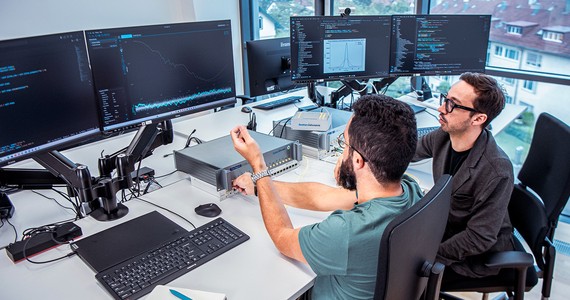
Swabian Instruments delivers fast, expert-level support led by application scientists specializing in photonics, quantum optics, timing & frequency, life sciences, and software development. With an average first-response time of four hours, users receive reliable guidance, complemented by extensive documentation, Python examples, and a comprehensive FAQ, to troubleshoot and optimize experimental setups.
查看更多内容