
时间与频率计量
Download BrochureWhat is Timing and Frequency Analysis?
Timing and frequency analysis is the measurement of how stable a clock, oscillator or reference signal is over time, and how well different systems stay synchronized to each other. It is essential in telecommunications, satellite navigation, precision manufacturing and scientific research, wherever systems must agree on time to within nanoseconds or picoseconds. Characterizing clocks and synchronization systems requires tools that resolve extremely small timing variations.
Timing and synchronization applications we support
Frequency Stability Analysis
Role of timing electronics in Frequency Stability Analysis

Phase Noise Analysis
Phase noise analysis characterizes the short-term stability of oscillators, synthesizers, and timing-distribution paths through the single-sideband spectrum L(f). Swabian Instruments' Time Tagger uses timestamp-based measurements to derive L(f), integrated jitter, and Allan deviation from a single time-tag stream. It also supports multi-channel acquisition on a common time base and cross-correlation for a lower measurement floor.

Pulse-Per-Second (1PPS) Monitoring
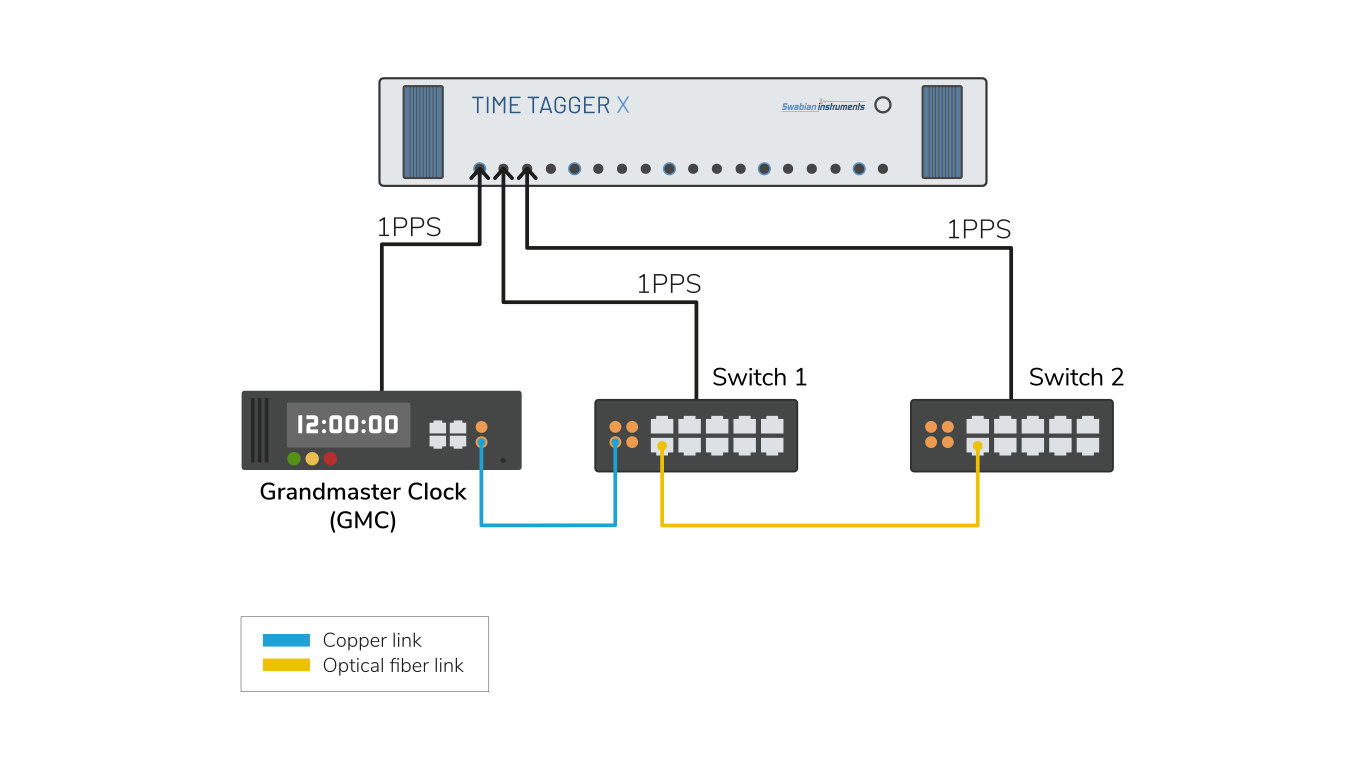
1 pulse per second monitoring is used to keep clocks aligned and to check timing stability when devices are separated by distance. A 1PPS signal marks the start of each UTC second and is commonly produced by GNSS, including GPS timing receivers or GPS-disciplined oscillators. This page describes where 1PPS is used in practice, including telecommunications, navigation, finance, metrology, and distributed scientific experiments.
Why is Time Tagging important for Timing and Sync applications?
A Time Tagger records the exact arrival time of every edge on every input channel, with picosecond resolution. From these raw timestamps, Swabian Instruments software computes Allan deviation, time interval error, phase noise and other stability metrics directly, on a single multichannel platform. This lets engineers evaluate synchronization performance, find sources of timing noise and validate system stability without separate instruments for each measurement.