
物质与遥感科学
What is time-resolved materials characterization?
Time-resolved materials characterization measures how a material responds in the first picoseconds to microseconds after optical or electrical excitation. Many material properties, such as carrier lifetimes, emission dynamics and phase transitions, only show up on these short timescales. Resolving them is essential for developing materials for electronics, photonics, quantum sensing, aerospace and renewable energy.
Materials science applications we support
卫星激光测距(SLR)与激光雷达(LiDAR):高精度遥感解决方案
Next-generation multi-angle DLS turnkey design with built-in consistency checks, raw photon access, and intelligent spike filtering for fast, reliable particle sizing.

光探测磁共振 (ODMR)
Optically detected magnetic resonance (ODMR) is a powerful technique widely used in quantum sensing, magnetic field measurement, and material analysis.

布里渊光散射(BLS)
布里渊光散射(Brillouin Light Scattering,BLS)是一种功能强大的光学光谱技术,可用于研究材料中的声子、磁振子以及黏弹性特性,广泛应用于固体材料、生物医学和传感等领域。Swabian Instruments - 施瓦本仪器® Time Tagger 在现代 BLS 实验中发挥着重要作用,可实现皮秒级光子时间标签记录、与干涉测量系统的可靠同步,以及频率分辨光谱的实时重建。通过将 Time Tagger 与 Fabry–Pérot 干涉仪和单光子探测技术相结合,研究人员能够实现高精度、可扩展且具备时间分辨能力的布里渊光散射测量,为材料科学、自旋电子学、生物医学研究和遥感等应用提供有力支持。

Electron Paramagnetic Resonance (EPR) / Electron Spin Resonance (ESR)
Electron paramagnetic resonance (EPR) is a powerful spectroscopy technique used to study materials with unpaired electrons through continuous-wave or pulsed microwave measurements. Advanced pulsed EPR experiments require precise synchronization, nanosecond pulse control, and low timing jitter. The Swabian Instruments Pulse Streamer 8/2 provides the high-speed, multi-channel timing control needed to reliably orchestrate complex pulsed EPR experiments.

量子点单光子源表征
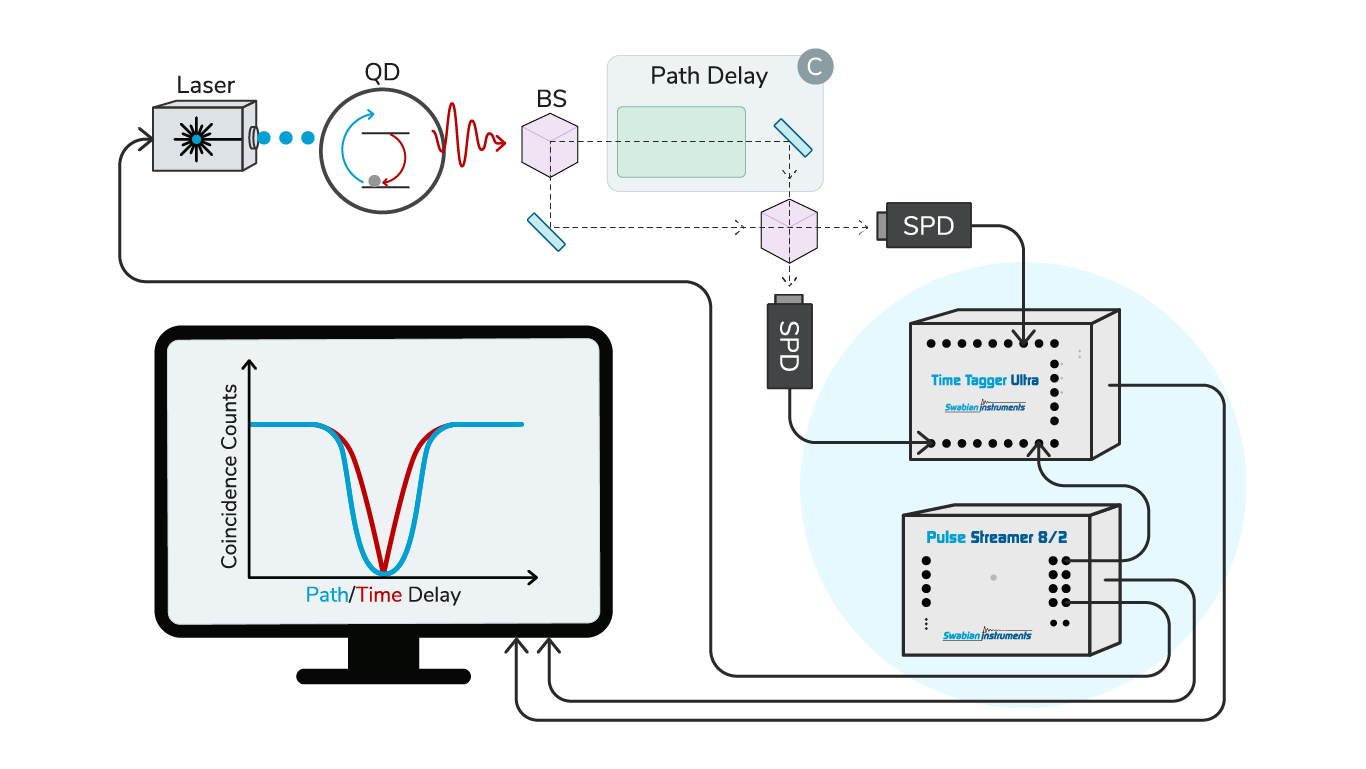
Swabian Instruments - 施瓦本仪器® Time Tagger 和 Pulse Streamer 具备皮秒级时间分辨率、高速数字脉冲生成和高数据吞吐能力,为量子点单光子源的表征提供可靠支持。
Why is Time Tagging important for Materials Science?
Time-correlated single photon counting (TCSPC) lets researchers observe transient optical phenomena with picosecond precision. Swabian Instruments Time Taggers record the arrival time of every detected photon and stream the raw data, so lifetime histograms and time-resolved spectra can be built live and re-analyzed later. For experiments that need synchronized excitation pulses, gates and detectors, the Pulse Streamer Series provides the timing signals.