1 Pulse Per Second Monitoring (1PPS)
1PPS Applicability for Synchronization
A 1 Pulse Per Second (1PPS) signal is a sharply rising and falling digital pulse emitted exactly once per second, and it is one of the simplest yet most important timing references in science and technology. It is commonly derived from Global Positioning System (GPS) or Global Navigation Satellite System (GNSS), atomic clocks, and other precision timing sources, and serves as a baseline for synchronization, verification, or drift monitoring.
The usefulness of 1 PPS lies in its highly precise and clean timing edge, which is often leveraged to mark the start of each Coordinated Universal Time (UTC) second with high temporal fidelity. 1PPS signals are also essential for experiments that require maintaining synchronized clocks across independent devices by providing a shared, repeatable timing edge that allows measurements acquired remotely to be placed on the same time axis for reliable comparison. Common applications in which 1PPS signals are critical include telecommunications system propagation delay, position, and navigation, financial server and stock market synchronization, time synchronization in cosmic ray detectors1, and time-and-frequency metrology laboratories2.
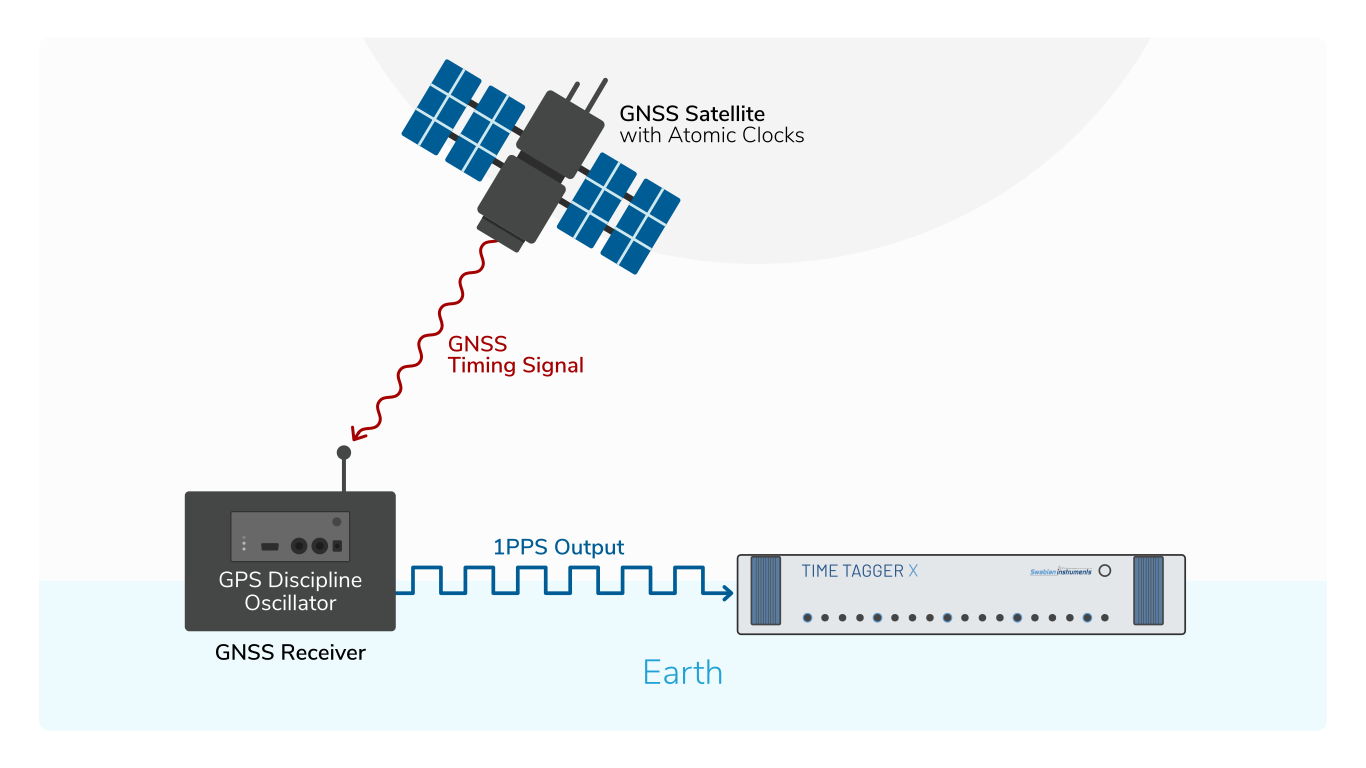
In practice, the current state of the art for achieving this kind of long-distance synchronization relies on GNSS, which hosts atomic clocks in satellites that are continuously monitored and compared to reference “master” clocks to broadcast precise timing information to Earth. Atomic clocks are highly accurate yet expensive, therefore impractical for deployment in every system. The ‘GPS time’ is steered to within one microsecond of Universal Time so that GPS receivers provide 1 PPS output signal. This pulse normally has a rising edge aligned with the GPS second, and is used to discipline local clocks to maintain synchronization with Universal Time (UT).
Accessing this timing directly is technically demanding as it requires a GNSS antenna with sky visibility, tracking of multiple satellites, and correction for atmospheric and propagation delays. A dedicated GNSS receiver, therefore, performs these complex timing calculations and reconstructs the exact UTC second boundaries. The purpose of the 1PPS output is to generate a clean electrical signal that indicates the position of the time interval or navigation message, with some time delay. Any connected device can then use this 1PPS to align its local clock and prevent long-term drift, without requiring direct access to satellite signals or its own high-precision oscillator.
Areas of Application for 1 PPS Signals
The 1 PPS signal is widely used across scientific and industrial domains wherever precise timing and synchronization are required. Although the signal itself is simply a single pulse marking the start of each UTC second, it provides the foundation for accurate temporal alignment between devices, systems, and entire infrastructures.
In telecommunications, 1 PPS synchronization plays a central role in maintaining the phase and time alignment required across network elements. Modern 5G networks, particularly those operating in time-division duplex and utilizing coordinated multi-point transmission, depend on sub-microsecond to sub-nanosecond synchronization between base stations to ensure stable handovers, coherent transmissions, and efficient spectrum usage. A hardware-derived 1 PPS signal, obtained from GNSS timing receivers or high-stability reference clocks, provides a reliable absolute timing anchor that supports these synchronization requirements and allows network nodes to operate on a unified timescale3.
In metrology, 1 PPS monitoring supports the calibration and comparison of national and industrial frequency standards. Laboratories use 1 PPS outputs from GPS-disciplined oscillators or atomic clocks to verify traceability to UTC, quantify Allan deviation, and evaluate oscillator stability. Long-term measurements of 1 PPS offset and drift help refine the definition of time and frequency references4.
In satellite navigation, the 1 PPS signal serves as a bridge between ground and space timing standards. Ground stations and research facilities use 1 PPS comparisons to evaluate the timing performance of GNSS receivers and to correct systematic delays within timing transfer systems. For instance, studies of geodetic GPS receivers have shown that well-configured hardware 1 PPS outputs achieve timing accuracies better than 10 ns under stable conditions5.
In scientific research, distributed experiments often rely on 1 PPS to align instruments separated by large distances. Radio telescopes, particle detectors, and gravitational-wave observatories synchronize their data acquisition through shared 1 PPS timing grids. This synchronization enables precise coincidence detection and cross-correlation between measurement sites, allowing for the reconstruction of complex phenomena with high temporal fidelity6.
In financial trading systems, precise timing is required so that orders, trades, and market-data events can be timestamped and compared across different servers and locations. A GNSS-derived 1 PPS signal is commonly used as a hardware timing reference to align internal clocks to UTC and to verify that timestamping systems remain consistent over time. This approach is widely adopted in electronic and high-frequency trading infrastructures because it provides a stable, traceable time reference that can be distributed within data centers and monitored for drift or timing faults7.
Based on the variety of applications for which 1PPS monitoring is essential, the measurement itself is often considered to lie at the intersection of timing, frequency, and synchronization. While the 1PPS signal itself is simple, its accurate measurement and analysis carry enormous weight across industries and research domains.
Experimental Setup for 1PPS monitoring and Role of Timing Electronics
A typical measurement setup for 1 PPS monitoring begins with a stable 1 PPS source, which may be a GPS-disciplined oscillator (GPSDO) that combines a GNSS receiver with a local high-quality oscillator, such as an Oven-Controlled Crystal Oscillator (OCXO) or rubidium clock. The GPSDO ensures that the output 1 PPS is phase-aligned to UTC under steady-state operation, though transient offsets and uncertainties on the order of several nanoseconds may persist during lock acquisition or under environmental changes. The generated 1 PPS is then delivered to measurement equipment and possibly to synchronized systems via fan-out modules or matched-length coaxial/fiber cabling.
In parallel systems, a reference frequency (e.g., 10 MHz) is often maintained to support long-term stability analysis. This frequency reference allows timestamping systems to resolve fine phase/frequency differences over extended durations8. The distribution network must be designed to minimize path delay and jitter, which could otherwise degrade the effective timing precision. A common approach for remote synchronization is White Rabbit, which distributes frequency and time over Ethernet and can provide a 1 PPS output at each node that remains tightly aligned across a network; in such setups, both the frequency reference and the 1 PPS are often monitored to validate end-to-end synchronization performance.
The core component in the measurement chain is a high-performance timestamping device, which records the arrival time of each 1 PPS pulse relative to its internal reference or an external clock. Such instruments should stream event timestamps with picosecond-level resolution because many 1 PPS applications require verification of timing behavior well below one nanosecond; if the timestamp quantization or internal jitter of the measurement device is comparable to the effect under test, it becomes impossible to distinguish true source noise, distribution-induced fluctuations, and systematic offsets from measurement artefacts. Picosecond-level timestamping therefore provides sufficient headroom to resolve sub-nanosecond jitter, detect small phase excursions, and quantify slow drift over long observation windows.
Common Challenges in 1PPS Monitoring Experiments
Even though the intrinsic nature of a 1 PPS signal is simple, accurate 1 PPS monitoring faces several practical and technical challenges that limit achievable measurement fidelity and interpretability.
Insufficient timing resolution of measurement instruments: Many conventional timing instruments and frequency counters lack the resolution required to resolve sub-nanosecond variations in 1 PPS signals. When the instrument resolution approaches the magnitude of the timing effects under investigation, jitter, and small offsets cannot be reliably distinguished from measurement noise9.
Limited scalability across multiple channels or nodes: Real-world deployments often involve monitoring multiple 1 PPS sources simultaneously8, for example, across distributed network nodes. Instruments that are limited to single-channel or sequential measurements struggle to provide a coherent view of system-level synchronization behavior.
Long-term data volume and continuity constraints: Continuous 1 PPS monitoring over hours, days, or weeks generates large volumes of timestamp data. Capturing, storing, and processing this data without loss or interruption can become a bottleneck, particularly when long-term drift or rare timing excursions are of interest.
Restricted flexibility in timing analysis: Many timing instruments provide only predefined outputs. This limits the ability to compute custom metrics, investigate non-stationary behavior, or correlate timing data with external events or environmental conditions.
Swabian Instruments Solution for Flexible 1 Pulse Per Second Monitoring
Swabian Instruments Time Taggers address these challenges by combining precise hardware timing with scalable acquisition and flexible analysis capabilities.
Picosecond-level precision: High-resolution timestamping allows 1 PPS pulses to be measured with picosecond precision, ensuring that instrument noise and effects remain well below the timing variations being evaluated. This makes it possible to resolve sub-nanosecond jitter, detect small phase excursions, and accurately quantify timing offsets.
Multi-channel, parallel acquisition architecture: Support for multiple independent input channels enables simultaneous monitoring of several 1 PPS sources. This allows direct comparison of timing behavior across nodes or devices and provides a coherent system-level view of synchronization performance.
Continuous streaming and real-time data reduction: Streaming timestamp acquisition, combined with on-the-fly filtering and aggregation, enables long-duration measurements without overwhelming storage or data interfaces. This makes it feasible to observe slow drift, long-term stability, and rare timing events over extended periods.
Flexible software-based analysis access: Access to raw timestamp data, together with programmable analysis tools, enables users to compute custom metrics such as time-difference error, jitter histograms, Allan deviation, or time deviation. This flexibility supports both standard compliance testing and exploratory analysis.
Coherent handling of multiple timing references: The ability to accept both 1 PPS and frequency references (e.g., 10 MHz), apply configurable delays, and align measurements to a common time base enables consistent integration of heterogeneous timing sources. This is particularly important in distributed systems and network-based synchronization architectures.
Application Note
Measuring the Timing Accuracy and Jitter of 1PPS Signals in White Rabbit Applications
Accuracy_and_Jitter_of_1PPS_Swabian_Instruments.pdf
Remote Synchronization of Time Taggers with SubNanosecond Precision via White Rabbit
Remote_Synchronization_Swabian_Instruments.pdfD. Duchesne, et al., “Precision Time Calibration of GPS Clocks in a Few Nanosecond Range,” arXiv:physics/0311079, Oct. 14, 2003. [Online]. Available: https://arxiv.org/pdf/physics/0311079. Accessed: Jan. 21, 2026. ↩︎
R. Tian, J. Zhang, S. Zhang, L. Wang, H. Yang, Y. Chen, Y. Jiang, J. Lin, and L. Zhang, “A High-Precision Energy-Efficient GPS Time-Sync Method for High-Density Seismic Surveys,” Applied Sciences, vol. 10, no. 11, art. 3768, May 2020, doi: 10.3390/app10113768. ↩︎
D. Hagarty, “Synchronizing 5G Mobile Networks: Timing Assurance,” Cisco Live EMEA, BRKSPG-3050, 2025. [Online]. Available: https://www.ciscolive.com/c/dam/r/ciscolive/emea/docs/2025/pdf/BRKSPG-3050.pdf. Accessed: Jan. 21, 2026. ↩︎
P. Picard, J. Delport and J. Parks, “Evaluation of 1 PPS Accuracy in a GPS-Disciplined Oscillator,” Pendulum Instruments, Article v1 16-02-20, May 2022. [Online]. Available: https://pendulum-instruments.com/wp-content/uploads/2022/05/Article_Evaluation_of_1_PPS_accuracy_in_a_GPSDO_v1_16-02-20.pdf. Accessed: Jan. 21, 2026. ↩︎
S. Dan, P. Banerjee, R. Mondal, C. Koley, A. Bose, A. Agarwal and P. Kandpal, “Exploring the Timing Performance of a Geodetic GNSS Receiver in GPS-Only Mode,” MAPAN – Journal of Metrology Society of India, vol. 40, pp. 325–332, Jan. 2025, doi: 10.1007/s12647-025-00804-2. ↩︎
A. Ogrizović, M. S. Djordjević, P. M. Miljanić and D. J. Doğru, “Testing GPS Generated 1PPS Against a Rubidium Standard,” Acta IMEKO, vol. 2, no. 1, pp. 5–?, 2013. [Online]. Available: https://acta.imeko.org/index.php/acta-imeko/article/view/IMEKO-ACTA-02(2013)-01-05/156 . Accessed: Jan. 21, 2026. ↩︎
M. A. Lombardi, A. N. Novick, G. Neville-Neil, and B. Cooke, “Accurate, Traceable, and Verifiable Time Synchronization for World Financial Markets,” Journal of Research of the National Institute of Standards and Technology, vol. 121, pp. 436–463, Oct. 7, 2016, doi: 10.6028/jres.121.023. ↩︎
M. A. Lombardi, A. N. Novick, and V. S. Zhang, “Characterizing the Performance of GPS Disciplined Oscillators With Respect to UTC(NIST),” in Proc. 37th Annual Precise Time and Time Interval Systems and Applications Meeting, Vancouver, Canada, Aug. 2005, pp. 677–684. [Online]. Available: https://tsapps.nist.gov/publication/get_pdf.cfm?pub_id=50196. Accessed: Jan. 21, 2026. ↩︎ ↩︎
M. A. Lombardi, Fundamentals of Time and Frequency, National Institute of Standards and Technology, Gaithersburg, MD, USA, NIST Publication 1498, Apr. 2002. [Online]. Available: https://tf.nist.gov/general/pdf/1498.pdf. Accessed: Jan. 21, 2026. ↩︎